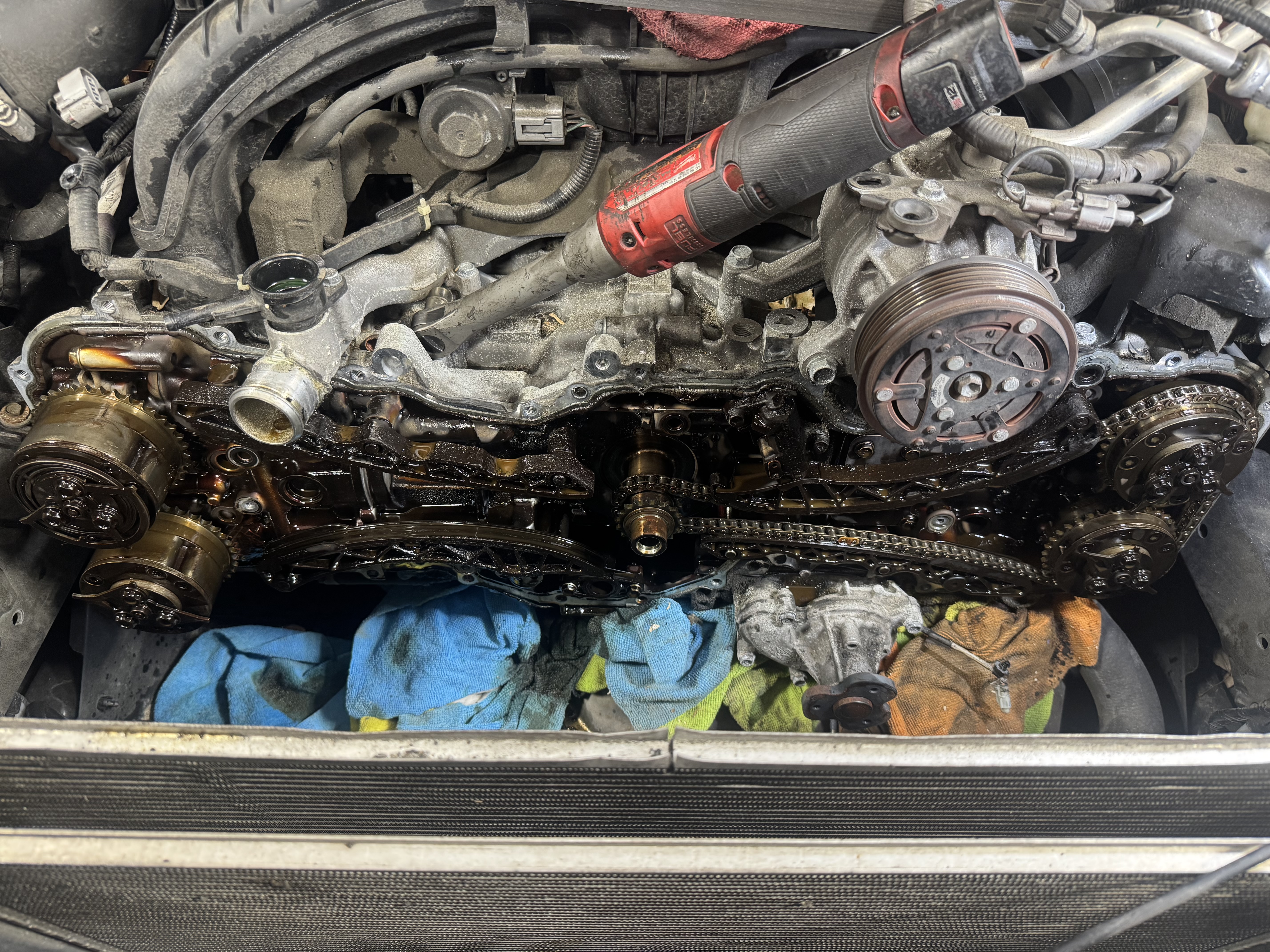
Granby CT case study: 2021 Subaru Impreza with oil in coolant, VVT codes, and a broken cam phaser. We diagnosed an upper oil pan cross-leak and performed a partial reseal.
This 2021 Subaru Impreza came to College Highway Auto in Granby, CT with a messy combination of symptoms: intermittent variable valve timing codes, a cold-start rattle, discolored coolant, and oil level concerns. The car had followed the long oil change intervals recommended by various service providers, stretching out to 7,000–10,000 miles between services. Over time that schedule led to thick, overheated oil, varnish formation, and seal shrinkage. On this engine, that cocktail created a path for oil and coolant to contaminate each other and stressed the variable valve timing system to the point of a broken camshaft phaser. Our job was to slow down, test methodically, and confirm where the fluids were crossing before recommending any repair. After diagnosis, we performed a targeted, partial reseal and addressed the damaged timing components. This write-up explains the symptoms we saw, the testing steps we used to find the real fault, and the repairs we completed to get this Impreza back to reliable service for its daily commute around Granby, East Granby, Simsbury, and the rest of Hartford County.
The owner first noticed a sweet but slightly burnt odor after drives, and the coolant reservoir looked darker than normal with a faint scum on the surface. The dipstick occasionally showed a light haze, and the engine’s top end had a brief rattle on cold start that went away quickly. The check engine light would come and go with variable valve timing codes present during some visits at other shops. We also observed: discoloration in the coolant overflow bottle; light oil film in the expansion tank neck; intermittent VVT performance codes and correlation faults on one bank; cold-start VVT rattle that shortened as the engine warmed and oil pressure stabilized; evidence of minor external oil wetness at the upper oil pan seam and front cover area; oil that smelled overcooked and carried fine suspended debris; and a rough idle after hot shutdown and restart, likely related to erratic phaser operation and oil aeration. Importantly, the car did not have a consistent overheating complaint and did not exhibit the classic continuous misfire pattern of a failed head gasket. That helped guide us away from blanket assumptions and toward Subaru-specific sealing points we see fail on these newer engines.
Our diagnosis process always starts with evidence, not guesses. On this 2021 Impreza we began with a visual inspection of the coolant reservoir, radiator neck, and oil filler cap. The coolant had a light oily sheen. The oil cap showed a faint milky haze that could be from short trips but took on more significance given the other clues. Next we scanned the vehicle with a Subaru-capable scan tool and captured freeze frame data and live PIDs for camshaft advance, oil temperature, coolant temperature, and VVT duty cycles. The ECU had stored variable valve timing performance codes and a learned cam/crank correlation offset on one bank. We then sampled the engine oil and coolant. A quick in-house screen looked positive for glycol marker in the oil. To confirm direction of travel, we performed a cooling system pressure test and let the engine sit for an extended period. The pressure slowly decayed without obvious external drips, and the oil level ticked upward slightly over several hours, suggesting coolant was capable of moving into the crankcase under pressure. To check the inverse pathway, we added UV dye to the oil, ran the engine briefly, then performed a cooling system pressure test again. Under borescope inspection at the upper oil pan to block interface, we observed dye-tinted seepage in a pattern consistent with a compromised upper oil pan sealant path, which on these engines can border oil galleries and nearby coolant passages. We also pulled and inspected the variable valve timing oil control solenoids and their screens. They showed varnish and fines, telling us the oil had been working too hard for too long. Using the scan tool, we commanded VVT changes and observed delayed and inconsistent cam response on the affected bank. With the front covers off during teardown, we found the smoking gun for the timing complaint: a broken internal stop in the camshaft phaser (sprocket), which explains the correlation and startup rattle. Before recommending any repair, we also ruled out common red herrings. The oil cooler was pressure tested and showed no breach. Combustion leak testing of the cooling system was negative for hydrocarbons, and there was no persistent misfire signature to support an active head gasket failure. Taken together, the test data pointed to two related but separate issues driven by oil quality history: a cross-contamination path at the upper oil pan sealant interface, and a failed cam phaser aggravated by varnish and debris. That combination aligns with what we’ve been seeing around Hartford County on FB-series Subaru engines that run extended oil intervals.
Because the evidence supported a contained cross-leak at the pan interface and not an internal block or head gasket breach, we recommended a partial reseal rather than an invasive engine teardown. Once the customer approved, we proceeded with the following steps. First, we drained the contaminated coolant and oil and captured a baseline sample. The front subframe components were supported to create room, and we removed the exhaust front pipe as needed for access. The lower oil pan came off and we inspected the pickup screen; fines were present but no chunks. We replaced the pickup O-ring and cleaned the screen carefully. With the lower pan off, we removed the upper oil pan, which on this engine is a structural cast section sealed with form-in-place sealant. The old sealant was brittle and shrunk back in several spots, especially near oil gallery sections that sit adjacent to coolant routes. The mating surfaces were thoroughly cleaned, checked for straightness, and prepped with the correct Subaru-spec sealant in the precise bead pattern and timing window so the seal lands and cures correctly. We reinstalled the upper pan and torqued in sequence, then resealed the lower pan with a fresh gasket and sealant where specified. While in there, we inspected the front timing cover. There was evidence of minor weeping at the cover perimeter, so we removed, cleaned, and resealed the timing cover with the correct sealant. With the covers off, we addressed the variable valve timing concerns. The broken camshaft phaser on the affected bank was replaced with a new OEM unit. The cam seals were renewed, and both VVT oil control solenoids were removed, cleaned, and tested. Given the varnish we found, we opted to replace the affected solenoid as a preventive measure once testing showed sluggish operation under hot oil conditions. New OEM seals and O-rings were used throughout the repair to eliminate any future vacuum or pressure cross-talk. Once the sealing work was complete, we reassembled the front end and allowed the sealants their required cure time. The cooling system was flushed with a detergent-free method until clear, then refilled with the correct Subaru-compatible coolant and conditioner if specified by the service bulletin for this model year. We refilled the engine with full synthetic 5W-30 and a quality filter. We then performed a multi-stage oil service strategy: a short initial run-in period followed by an early oil and filter change to remove any residuals, then a second check after 300–500 miles to verify the oil stayed clean and the coolant remained free of oil. Post-repair validation matters. We re-scanned the ECU, verified cam timing correlation was within spec, and confirmed commanded VVT angles tracked properly under different loads and temperatures. Cooling system pressure held steady, there was no oil rise with the engine off, and no sheen reappeared in the coolant bottle during follow-up. We road-tested the vehicle across varying conditions in and around Granby, East Granby, Simsbury, and Suffield to confirm stable operation. Just as important, we reviewed future maintenance with the owner to prevent a repeat. For these Subaru engines, we recommend full synthetic 5W-30 and a 3,000-mile interval to keep the oil fresh, detergents active, and sealants happy. Extended intervals are not your friend here; that extra time simply bakes the oil and accelerates varnish formation. If you previously ran 0W-20, our experience and this case support stepping up to 5W-30 full synthetic for improved film strength and VVT stability in real-world Hartford County driving.
Fluid cross-contamination is not just a housekeeping issue. Oil in the coolant can soften hoses and degrade heat transfer, while coolant in the oil strips the additives your bearings and cam phasers depend on. On Subaru FB engines, the variable valve timing system is especially sensitive to oil quality and pressure. Sludge and varnish slow the oil control solenoids, unbalance the cam phasers, and cause startup rattle that hammers timing components. Over time, the wear compounds, phasers can fail mechanically, and seals shrink, creating those crossover paths we found on this Impreza. Preventing this is straightforward but requires discipline: use a quality full synthetic 5W-30, change it at 3,000 miles, and don’t let the oil run long and hot. Short trips, hot summers, and highway commutes around Granby and Hartford County all count as severe service in the real world. Keeping the oil clean protects the VVT system and preserves the integrity of sealant joints such as the upper oil pan and timing cover. If you see a sheen in the coolant bottle, smell a sweet but burnt odor, or hear a cold-start rattle, don’t ignore it. Early diagnosis generally means a targeted partial reseal and cleaning can solve the problem. Waiting often turns a maintainable issue into a major overhaul. At College Highway Auto, we’ll always test first, explain the findings, and tailor the repair to what your Subaru actually needs.
We often find sealing breakdowns at the upper oil pan and occasionally the timing cover on FB-series engines. Long oil intervals overheat and oxidize the oil, shrink sealant paths, and allow oil and coolant to cross-contaminate. While oil coolers and head gaskets can fail, they are not the default cause on these models, so we test before replacing parts.
Look for a faint oily film in the coolant bottle, a burnt-sweet smell after driving, a cold-start rattle from the timing area, intermittent variable valve timing (VVT) codes, subtle idle changes after a hot soak, rising oil level, or unexplained coolant loss without obvious leaks.
It’s risky. Coolant in the oil can strip additives and reduce lubrication, damaging bearings and cam phasers. Oil in the coolant compromises heat transfer and softens hoses. Short trips to a trusted shop may be okay, but extended driving can turn a manageable repair into a major overhaul. We recommend scheduling a diagnosis promptly.
We combine a cooling system pressure test, oil screening for glycol markers, borescope inspection at known Subaru sealing interfaces, UV dye tracing where appropriate, and scan-tool evaluation of VVT performance. We also rule out oil cooler breaches and check for combustion gases in the coolant to avoid misdiagnosing a head gasket.
A partial reseal targets the interfaces most prone to leakage without tearing down the entire engine. Typically this includes removing and resealing the upper oil pan with the correct bead pattern and cure time, resealing the lower pan, and resealing the front timing cover if needed. During the process we inspect and service the oil pickup, cam seals, and VVT components.
Phasers rely on clean, pressurized oil to change cam timing. Extended oil intervals promote varnish and debris that slow the control solenoids and starve the phaser of stable pressure. Repeated cold-start events with poor oil condition can hammer the mechanism until it breaks internally, creating timing correlation faults and a rattle.
Yes. In our real-world Granby and Hartford County climate, full synthetic 5W-30 provides better film strength and VVT stability than 0W-20 in these engines, especially as they age. More importantly, change it at 3,000 miles. Clean oil and consistent service intervals protect the phasers, solenoids, and sealant interfaces that keep oil and coolant separated.
Costs vary with what we find in testing. A partial reseal with upper oil pan and timing cover, plus addressing VVT components, can range widely depending on parts and labor, and whether additional components (like a cam phaser or oil control solenoid) are required. We provide a detailed estimate after diagnosis so you know exactly what your Subaru needs.
Most partial reseal jobs take one to three days once parts are available, allowing for proper sealant cure time and post-repair validation. We stand behind our workmanship and parts with a solid warranty; details are provided on your estimate and invoice.
Yes. Short trips don’t fully warm the oil and can accelerate moisture buildup and varnish formation. Combined with long intervals, this is a recipe for sticky VVT components and seal shrinkage. That’s why we emphasize full synthetic 5W-30 and 3,000-mile services for vehicles that see daily short local drives.