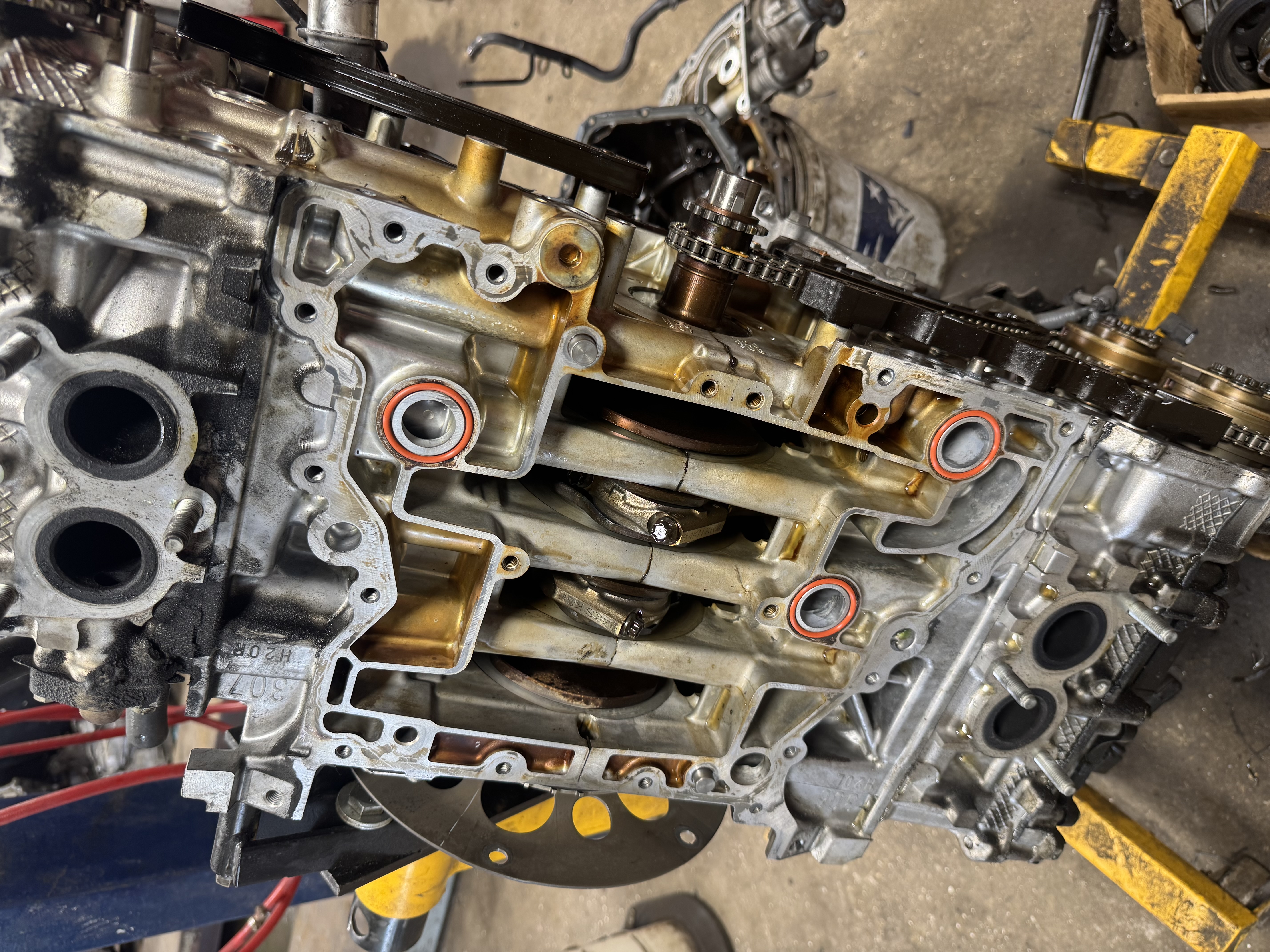
Oil in your Subaru’s coolant? In Granby CT, College Highway Auto diagnoses the real cause—often upper oil pan/bed-plate sealing on late-model Subarus—and performs proven engine reseals. Learn symptoms, tests, and our repair approach.
Another Subaru rolled into our Granby, CT bay with oil showing up in the radiator. We see this more than you might think, and long oil change intervals are a big part of why. When oil and coolant mix, it’s tempting to assume a blown head gasket or a bad oil cooler. On these Subarus, however, we frequently trace the problem back to hardened sealant at the upper oil pan (also called the bed plate or lower crankcase) and related front engine sealing points where oil and coolant passages live close together. As the factory sealant ages—especially on engines that go 6,000–10,000 miles or more between oil changes—it can harden, shrink, and lose its bond. That’s when cross-contamination can start.
Before we reach for gaskets and sealant, we test. A thorough diagnosis separates a real leak path from an assumption. In Hartford County, word travels, and we’d rather earn trust by proving the failure than replacing parts without confirmation. Below we’ll walk you through the exact Subaru-specific symptoms we look for, the tests we run, and the engine reseal steps we take when the evidence points to sealing breakdown rather than a head gasket or oil cooler.
If you’re in Granby, East Granby, Simsbury, Suffield, Southwick, Windsor Locks, Avon, Bloomfield, or anywhere nearby and you’re seeing oil in the radiator or a milkshake in the overflow, here’s how we can help—without guesswork.
Common signs your Subaru may have oil contaminating the coolant:
- Brown or tan oil film floating in the radiator, overflow bottle, or under the radiator cap - Sludgy “mayonnaise” buildup in the expansion tank neck - Swollen or softened coolant hoses (oil attacks rubber over time) - Cooling system smells slightly like engine oil - Reduced heater performance or intermittent overheating due to radiator efficiency loss - No white smoke, no misfire, and normal compression—even while oil appears in coolant (a clue it might not be a classic head gasket) - Oily residue around the upper oil pan seam, front cover, or timing cover area
Symptoms can be subtle at first. Some customers only notice a film in the overflow after a long highway run up Route 10 or Route 20 through Granby. Catching it early matters; oil in coolant reduces heat transfer and can shorten the life of the radiator, heater core, and hoses.
We don’t guess—we test. Subaru engines have several potential paths for oil and coolant to mingle. While head gaskets and oil coolers are known suspects, they are not automatic conclusions. Here’s the process we follow at College Highway Auto:
1) Visual and fluid inspection - Inspect radiator, overflow tank, oil cap, and dipstick for cross-contamination. - Sample coolant and engine oil to assess level of mixing. Oil-in-coolant is not the same as coolant-in-oil; each points to different likely sources and severities.
2) Cooling system pressure test—cold and warm - Pressurize the cooling system and monitor for pressure drop. - Inspect the upper oil pan/bed-plate seam, front timing cover, and nearby galleries for external weeping. - If the cooling system loses pressure with no visible coolant leaks, we note that for further isolation testing.
3) Oil system isolation tests - With the cooling system at rest, we perform a controlled oil pressure test (engine off) to see if oil pressure leaks into coolant passages under pressure. - We use UV dye in the oil and inspect the coolant and engine exterior with a UV light after running. Dye appearing in coolant—but not vice versa—suggests an oil-to-coolant leak path.
4) Chemical block test (combustion leak test) - We test for combustion gases in the coolant. A positive test could indicate a head gasket, cracked head, or block issue. On many of the Subaru cases we see with only oil in coolant and no overheating/misfire, this test is negative.
5) Oil cooler evaluation (if equipped) - Many Subarus have a sandwich-style oil cooler by the oil filter. We check for internal cooler failure and O-ring issues, but we don’t default to it. Coolers can fail, but on late-model Subarus with oil-in-coolant and no coolant-in-oil, we often find they’re fine.
6) Upper oil pan/bed-plate and front cover inspection - Subaru uses a formed-in-place gasket (FIPG) sealant for the upper oil pan/bed-plate and front cover. Over time—especially with extended oil change intervals—the sealant hardens and loses elasticity. - We inspect seam areas closely for seepage, and in some models, we borescope accessible cavities to look for oil trails near coolant passages.
7) Cooling system contamination pattern - Oil typically floats and can accumulate in high points of the radiator and expansion tank. We look for a consistent oil film pattern and verify there’s no chocolate milk in the crankcase—if oil looks normal and only coolant shows oil, that supports an oil-to-coolant leak path rather than severe head gasket failure.
8) Confirm and document - We compile test results, photos, and pressure readings. If the evidence points to the upper oil pan/bed-plate and front cover sealing areas, we’ll recommend a targeted engine reseal. If testing instead points to a head gasket or a failed cooler, we’ll show you exactly why.
This measured approach prevents throwing parts at the car and protects your wallet. We’ve had multiple Granby-area customers arrive convinced it’s a head gasket, only to learn the head gasket is fine and the real culprit is aged sealant at the upper pan or cover.
When testing confirms the leak path, we plan the repair around reliability and long-term cleanliness. On Subarus with oil in the coolant caused by sealing breakdown, here’s what our engine reseal typically includes:
1) Engine removal and teardown access - Removing the engine allows us to properly clean, prep, and reseal critical surfaces. Doing this in-car is tempting, but surface prep and sealant application quality suffer. We aim for the repair that lasts.
2) Upper oil pan/bed-plate reseal - We carefully strip the factory FIPG from the bed-plate and block mating surfaces without gouging aluminum. - Surfaces are solvent-cleaned, lint-free wiped, and prepped to ensure maximum sealant adhesion. - We apply the correct modern FIPG pattern and bead size at the specified locations, paying special attention to corners and oil/coolant adjacency points. - Fasteners are torqued in proper sequence to maintain alignment and even squeeze-out.
3) Front cover/timing cover reseal and related seals - If evidence shows seepage at the front cover, we reseal it during the same operation. - Replace camshaft seals, front crank seal, and any suspect O-rings or grommets that can weep oil.
4) Oil cooler service (if equipped) - Inspect and pressure test the cooler; replace its O-ring as preventive maintenance. Only replace the cooler itself if it fails testing—no parts tossing.
5) Valve cover gaskets and spark plug tube seals - With the engine out, it’s the smart time to address common seep points so you’re not back in here for minor leaks.
6) Cooling system decontamination - Flush the radiator, heater core, and engine passages thoroughly to remove oil residue. Oil films reduce heat transfer and can soften hoses. - Replace hoses that show swelling or soft spots. - Refill with the correct Subaru-compatible coolant and properly bleed the system.
7) Oil system service - Drain, replace filter, and refill with full synthetic 5W-30. - We recommend 3,000-mile intervals on these engines to keep the inside clean and extend seal life. Extended intervals are a major contributor to hardened sealant.
8) Post-repair verification - Cooling system pressure test and road test. - Recheck for any oil weeping, confirm heater performance, and verify the overflow remains clean after several heat cycles.
Timeline and communication - Most Subaru reseals like this take 1–2 full days once parts are in, depending on findings. - We’ll provide a written estimate after diagnosis. If testing points to a different root cause (such as a head gasket), we’ll adjust the plan and explain the tradeoffs before work begins.
What you get from doing it right - A tight, dry engine with restored separation between oil and coolant circuits. - A clean, efficient cooling system that won’t fight an oil film. - Peace of mind for New England commutes and the weekend runs through Granby, Simsbury, or the hills toward Southwick.
Oil in the coolant is not just a cosmetic issue. Even a small amount of oil can:
- Reduce the radiator’s ability to shed heat, inviting overheating on long grades or summer traffic. - Coat the heater core and reduce cabin heat output—annoying in a Hartford County winter. - Soften and swell rubber hoses, leading to premature failures and sudden leaks. - Create sludge pockets that trap heat in the cylinder heads. - Mask other cooling issues because the system becomes inconsistent.
Left alone, cross-contamination can escalate repairs from a manageable reseal and system clean-out to a radiator, heater core, and hose replacement. Worst-case, if coolant begins to enter the oil, it can threaten bearings and shorten engine life. Acting early prevents a small sealing problem from becoming a big reliability and safety issue.
Maintenance matters here. We strongly recommend full synthetic 5W-30 and 3,000-mile oil changes on these Subaru engines. Shorter intervals keep the detergents fresh and the inside of the engine clean, which helps FIPG sealant retain its elasticity and seal properly. We routinely see better long-term results for Granby-area drivers who keep to this schedule, especially with stop-and-go and seasonal temperature swings.
At College Highway Auto, we apply the same approach on every car: confirm, explain, and fix it right. That’s why neighbors from Granby, East Granby, Suffield, Simsbury, Windsor Locks, and Bloomfield keep us on speed dial for tricky Subaru issues like this.
No. While head gaskets can fail, we routinely find that oil-in-coolant on certain Subarus is caused by hardened FIPG sealant at the upper oil pan/bed-plate or front cover areas where oil and coolant passages are close. We confirm with pressure testing, UV dye, and a combustion leak test before recommending any repair.
It’s possible, and we always test the oil cooler if your Subaru has one. However, in our Granby shop’s experience, many cases with oil floating in the coolant and no coolant in the oil are traced to sealing breakdown at the upper oil pan/bed-plate or front cover rather than a failed cooler core. We verify before replacing parts.
Short trips to get diagnosed are usually fine, but extended driving can damage hoses, reduce radiator efficiency, and lead to overheating. Oil softens rubber and can coat the heater core. We recommend scheduling a prompt diagnosis so we can stop the contamination and protect the cooling system.
We inspect fluids, pressure test the cooling system cold and warm, use UV dye in the oil to see if it appears in coolant, perform a combustion leak test to check for head gasket issues, evaluate the oil cooler if equipped, and inspect the upper oil pan/bed-plate and front cover seams. We document results with photos and readings before presenting options.
When testing points to sealing failure, we remove the engine for access, reseal the upper oil pan/bed-plate and often the front cover with the correct FIPG sealant, replace related seals (cam, crank, valve cover, and O-rings), service the oil cooler O-ring, and thoroughly flush the cooling system. We finish with full synthetic 5W-30, a new filter, and post-repair pressure tests.
Typically 1–2 days once parts are on hand, depending on findings. We’ll provide a written estimate and timeline after diagnosis. If testing reveals a different root cause—such as a head gasket—we’ll explain options and adjust the plan accordingly.
Extended intervals accelerate deposit formation and allow the formed-in-place gasket (FIPG) sealant to harden and shrink. Hardened sealant is more likely to lose its bond, opening leak paths between oil and coolant passages. We recommend full synthetic 5W-30 and 3,000-mile oil changes for these engines to keep seals healthy.
Follow 3,000-mile oil change intervals with quality full synthetic 5W-30, monitor the overflow tank for any film, and have the cooling system inspected at regular service visits. Clean oil helps keep internal seals and FIPG more stable over time.
Yes. We regularly help drivers from Granby, East Granby, Simsbury, Suffield, Southwick, Windsor Locks, Avon, Bloomfield, and the rest of Hartford County. If you can get the car to us, we’ll diagnose and repair it the right way.
We stand behind our workmanship. Warranty details are provided with your estimate and invoice and depend on parts used and the scope of the repair. We’ll review coverage clearly before any work begins.