Subaru Forester cranks but won’t start? We traced a Bank 2 camshaft sensor code to rodent-chewed wiring. Granby CT diagnostics and repair that fix the real cause.
This Subaru Forester rolled into College Highway Auto on a flatbed after a frustrating weekend for its owner: strong crank, no start. The check engine light had been on prior to the failure, and when it finally quit, it wouldn’t fire back up. Our scan tool pulled a camshaft position sensor code for Bank 2. That’s a common enough starting point, but it doesn’t always mean the sensor is bad. In Hartford County, we see another culprit far too often—critters.
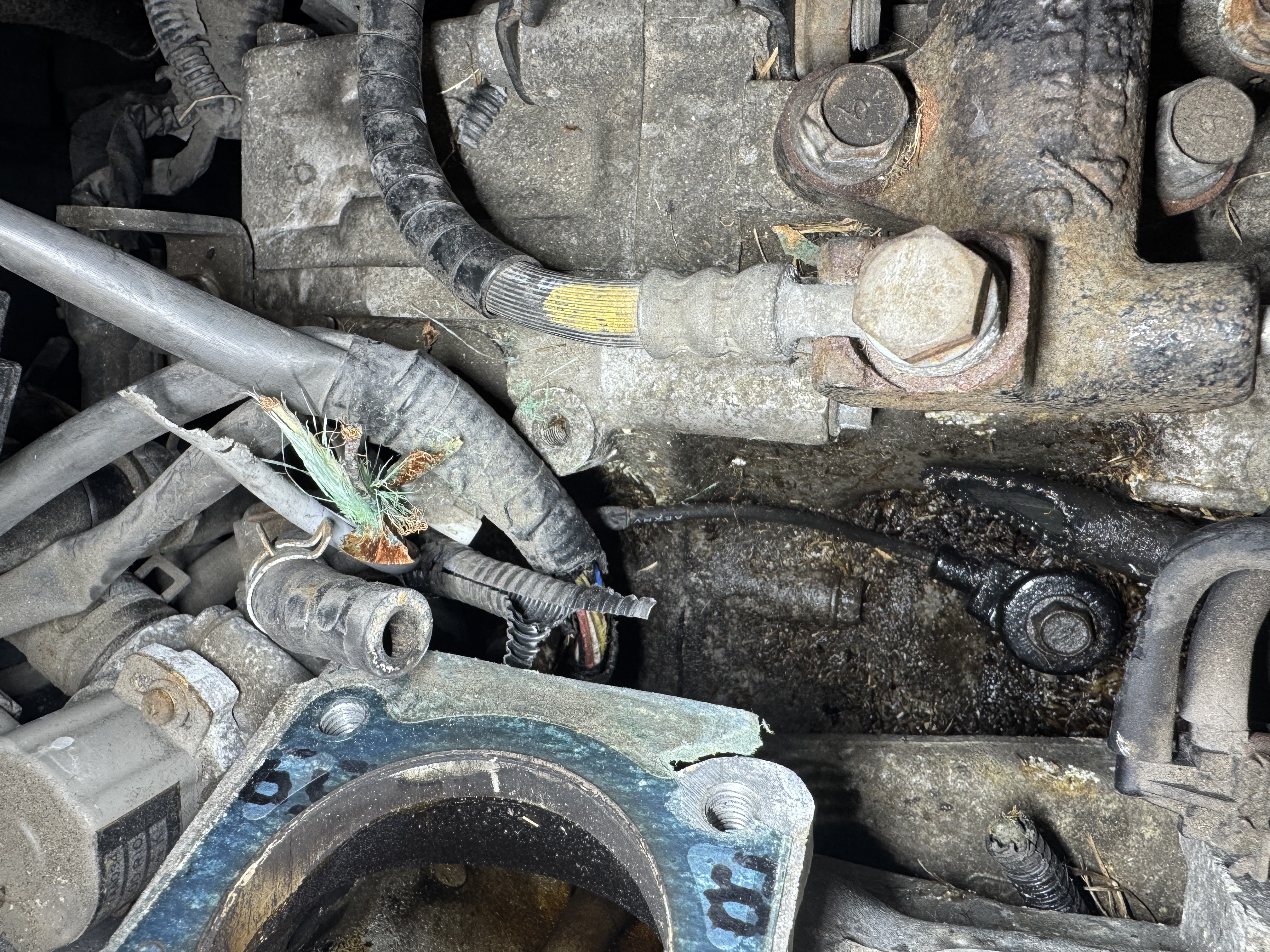
As we worked through the diagnostic routine, electrical tests pointed to an open circuit on the cam sensor’s wiring. Following the harness a little deeper, we found it: a compact mouse condo under the intake runner and three chewed wires. That was the entire reason this Forester cranked its heart out and never started. No fuel or spark strategy works correctly if the engine computer can’t trust cam timing information.
Below we’ll show how we diagnosed the fault without guessing, the proper way to repair damaged wiring on a modern Subaru, and how to protect your car from rodents. If you live in Granby, East Granby, Simsbury, or anywhere around Hartford County, this is the kind of real-world issue we solve every day—thoroughly and professionally.
What the owner noticed before calling the tow truck:
- Engine cranks normally, but never catches or runs - Check engine light had been on; scan showed a camshaft sensor Bank 2 code - No unusual mechanical noises while cranking - Occasional fuel smell after repeated start attempts - Battery recently replaced; starter sounded strong
What we observed at the shop in Granby, CT:
- Consistent crank speed with good voltage - Stable RPM signal on the scan tool from the crankshaft sensor - No synchronized engine start due to missing camshaft signal on Bank 2 - No injector pulse/ignition timing strategy consistent with a missing cam input during crank - Secondary clues: debris and seed husks near the cowl area—classic rodent sign
Modern Subarus rely on both crankshaft and camshaft position signals to coordinate fuel injection and ignition timing. When the ECU loses Bank 2 camshaft input, it often won’t start because timing can’t be confirmed. That doesn’t automatically implicate the sensor. A failed sensor, damaged reluctor, poor power/ground, or a broken wire can all trigger the same code.
Our diagnostic steps on this Forester:
1) Verify the symptom and pull codes - We verified strong crank with no start. The ECU stored a camshaft position sensor Bank 2 circuit code and pending sync errors. Freeze-frame data showed the failure occurred at low RPM during crank—consistent with a hard no-start.
2) Check basics: battery, fuses, and powers/grounds - Battery voltage under load was healthy. Engine and ECU grounds checked clean with low voltage drop. Relevant fuses for engine management were intact.
3) Live data review - The scan tool showed a steady crank RPM signal (good crank sensor input), but camshaft position for Bank 2 was reading “not plausible/no signal.” Bank 1 looked normal. That asymmetry often points to a localized issue on one side of the engine—sensor, connector, or harness section.
4) Scope testing the cam sensor circuit - We back-probed the Bank 2 cam sensor connector to scope the three-wire circuit: 5V reference (or 12V feed depending on sensor design), ground, and signal. On this vehicle, the signal trace was flat during crank—no rising and falling square wave as we’d expect. Power feed and ground were intermittently present when we flexed the harness. That’s a clue.
5) Harness inspection and load testing - We performed a loaded circuit test because a simple continuity check can miss high-resistance faults. Under a small test load, the circuit dropped out. Following the harness along the rear of the engine toward the Bank 2 cam sensor, we found nesting material tucked near the intake runner. A closer look revealed three wires with missing insulation and exposed copper—classic rodent chewing. Two were for the cam sensor circuit; one was a shared harness lead that could’ve caused other gremlins had it shorted.
6) Evaluate the sensor and reluctor - Before repairing, we unplugged the sensor and tested it at the connector; resistance and bias voltage were within spec. No signs of physical damage to the reluctor on visual inspection. With the harness fault confirmed, replacing the cam sensor would have been parts-cannon guesswork, not a fix.
7) Document and plan the repair - We photographed the damage for the customer. On many insurance policies, rodent damage may be covered under comprehensive. We explained options: OE pigtail replacement if needed, or high-quality weather-sealed wiring repair using correct gauge, insulation, and corrosion protection. The customer approved a professional harness repair and a thorough inspection for additional chews.
Why the engine wouldn’t start - Without a valid cam signal, the ECU can’t correctly time sequential injection and ignition during crank. Some vehicles can limp on crank-only input once running, but many won’t start without that cam sync. Our Forester was the latter: no cam sync, no start.
How we fixed it right the first time:
- Removed debris and the mouse nest: We carefully extracted nesting material and vacuumed the area to prevent foreign objects from getting into belts or sensors. We also inspected the cabin air intake and filter, a common rodent entry point that can fill with leaves and seeds.
- Repaired three damaged wires: We cut back to clean copper on each chewed lead. Using automotive-grade TXL wire of the correct gauge and color (where possible for future serviceability), we staggered the splices to avoid a bulky repair in a tight harness run. Each joint was made with sealed, crimped butt connectors and adhesive-lined heat-shrink for moisture protection. Where a connector shell had chafing, we replaced it with an OE-quality pigtail.
- Restored factory protection: We rewrapped the harness with high-temperature harness tape and added split-loom in high-risk rub points. A small rodent-deterrent sleeve was installed near the original nest area to discourage a return visit.
- Verified the repair electrically: With the oscilloscope reconnected, the Bank 2 cam sensor now showed a clean square wave during crank. Power and ground were steady with no dropouts during a wiggle test of the repaired section.
- Clear codes and confirm operation: We cleared stored and pending codes, performed a cold start, and confirmed instant startup with a stable idle. After warm-up, we road-tested the Forester through multiple drive cycles. No codes returned, and live data showed accurate cam correlation on both banks.
- Full underhood inspection: Because rodents rarely stop at one chew, we inspected adjacent wiring to the ignition coils, injectors, alternator, and EVAP purge solenoid, along with vacuum lines and the plastic intake snorkel. Everything else checked out.
When is replacement better than repair? - If multiple conductors are damaged right at a connector body or the terminals are corroded, a new OE pigtail is the best long-term fix. If chews run several feet, a sub-harness replacement may be more efficient. We discuss options with you up front so the solution fits your car and budget without compromising reliability.
Preventing a repeat - Park inside when possible and keep food sources away from the garage. - Pop the hood every week or two if a vehicle sits; a quick look can catch a small nest before it becomes a big problem. - Consider rodent deterrents designed for engine bays. We can recommend options we’ve seen work around Granby and Simsbury. - Keep cabin and engine air filters fresh; a clogged, leaf-filled filter housing is a rodent magnet.
Why this matters to you and your Subaru:
- No-starts rarely fix themselves. Repeated cranking risks draining the battery, flooding the engine, and overheating the starter. A correct diagnosis saves time and protects components. - Guessing at sensors is expensive. A new cam sensor wouldn’t have restored cam sync with an open circuit. Accurate testing prevents the parts cannon approach. - Rodent damage can escalate. Today it’s a cam sensor lead; tomorrow it could be a shorted injector wire or a chewed main harness. Addressing it early avoids larger repairs and potential fire hazards. - Local know-how pays off. Here in Granby and across Hartford County, we see seasonal rodent issues more than most shops in urban areas. We know where they like to nest in Subarus and what to check next. - Protects resale and reliability. Properly documented wiring repairs using the right materials maintain long-term reliability and preserve your vehicle’s value.
Not necessarily. A Bank 2 cam sensor code can be caused by a failed sensor, damaged reluctor, missing power/ground, or a broken signal wire. On this Forester, the code was due to rodent-chewed wiring. We test the circuit with a scope and loaded checks before recommending any parts.
On Subaru flat-four engines, Bank 1 and Bank 2 refer to the left and right cylinder banks. Bank 2 is the side opposite Bank 1. The exact side can vary by model and orientation, so we always confirm using service information and live data.
Common signs include a sudden no-start, random electrical faults, debris or seeds under the hood, a musty odor, chewed insulation, and small nests near warm areas like the intake or cowl. If you see these, avoid repeated cranking and have the wiring inspected promptly.
Often yes. Many comprehensive insurance policies cover rodent damage to wiring. We can document the repair with photos and an estimate to help with your claim. Coverage varies, so check with your provider.
We cut back to clean copper, use correct-gauge automotive wire, stagger splices, and seal them with adhesive-lined heat-shrink or weather-tight connectors. We rewrap the harness and add abrasion protection. Where connectors are compromised, we use OE-quality pigtails.
It depends. Some vehicles may start and run poorly; others won’t start at all. Driving with a cam sync issue can cause misfires, poor fuel economy, and potential catalyst damage. It’s best to have it diagnosed quickly to prevent further issues.
Most no-start diagnostics are completed the same day. If the cause is rodent damage and access is reasonable, repairs often take a few hours. Extensive harness damage or parts sourcing for specific pigtails can add time. We’ll provide an upfront timeline after inspection.
Park indoors when possible, keep the area free of food and birdseed, open the hood periodically on vehicles that sit, and consider approved rodent deterrents. We can recommend products that have worked for customers around Granby and Simsbury.
Clearing a code won’t fix an underlying wiring or sensor failure. The ECU needs a valid cam signal to coordinate start-up. Once we repair the root cause and verify a clean signal on the scope, we clear codes and confirm it stays fixed through multiple drive cycles.
Rodent damage can affect any brand. We see it across Subaru, Toyota, Honda, GM, and others—especially in rural parts of Hartford County. Subarus have tight engine bays that make warm nesting spots, so they’re frequent visitors for this issue.