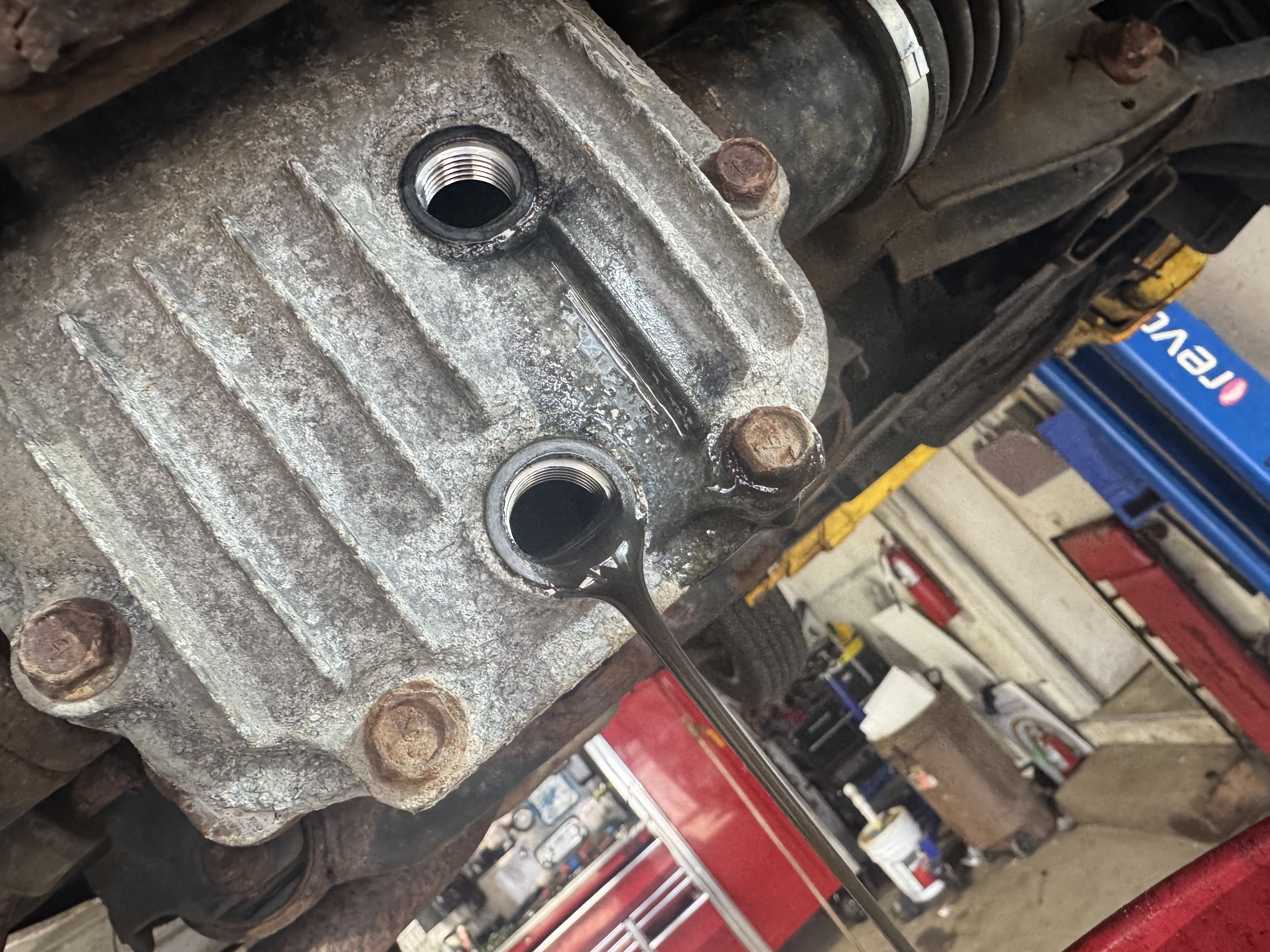
Change your differential fluids in Granby, CT. Prevent costly differential or even Subaru transmission failure. Expert AWD/4x4 service at College Highway Auto.
Change your differential fluids!! It’s the simple, inexpensive maintenance that quietly protects some of the most expensive parts on your vehicle. We see it all the time in Granby and across Hartford County: differentials run far too long on burned, contaminated fluid, and the first signs are a whine or a clunk that quickly turns into major repairs. On many Subarus, the front differential is integrated with or bolted to the transmission case. When that front diff fails due to dirty fluid or low fluid, the repair can require a transmission replacement. That’s a budget-buster no one wants, especially when fresh gear oil would have prevented it.
At College Highway Auto in Granby, CT, we service differentials on AWD Subarus, trucks, SUVs, and 4x4s from Simsbury, Suffield, East Granby, Southwick, Windsor Locks, and the greater Hartford County area. Our approach is practical and professional: confirm what’s going on, use the right fluid, service it cleanly, and verify the results. No guesswork. No upsell. Just the maintenance your drivetrain actually needs to stay quiet, cool, and reliable.
Whether you tow, commute, or do a mix of both, diff fluid is the lifeblood for ring-and-pinion gears, bearings, and limited-slip units. Heat, load, water intrusion, and metal wear particles all degrade that fluid. Fresh gear oil restores the protective film and the additive pack that prevents scuffing and pitting under heavy load. It’s not glamorous, but it’s the difference between a quiet drivetrain and a howling one—and in some vehicles, it’s the difference between routine maintenance and a multi-thousand-dollar failure.
How do you know it’s time to service the differential, or at least have us inspect it? Here are the real-world symptoms we hear from drivers in Granby and nearby towns:
- Whine or howling that changes with vehicle speed: A high-pitched whine on acceleration or a different tone on deceleration often points to ring-and-pinion wear or low, burned fluid. - Clunking or banging on throttle tip-in or when shifting from Drive to Reverse: Excessive backlash, worn U-joints, or diff mount issues can be involved. Dirty fluid accelerates wear. - Binding or shuddering on tight turns: Limited-slip differentials and clutch-type AWD units don’t like contaminated fluid; they can chatter and bind in parking lots. - Vibration under load or at highway speeds: Could be driveshaft, tires, or wheel bearings—but differentials with worn bearings and poor lubrication can contribute. - Burnt gear-oil smell: Gear oil that’s past its prime smells sharp and sulfurous. If you catch a whiff near the rear of the vehicle after a drive, it’s a red flag. - Visible leaks: Wetness around axle seals, pinion seals, or around the diff cover. Leaks reduce fluid level and increase heat and wear. - Metallic glitter on the magnet (from a previous service): Normal to see some paste at service intervals, but heavy chunks, flakes, or needle-like slivers indicate active wear. - For Subaru owners: On many automatics and CVTs, the front differential uses separate 75W-90 gear oil (not ATF/CVT fluid). If that gear oil gets neglected or leaks, the front diff can fail even while the transmission fluid looks fine. On many manual Subarus, the front diff and transmission share fluid—old, contaminated GL-5 can cause shifting issues and gear wear.
If you recognize any of these, or if it’s simply been years since your last differential service, it’s time to have us take a look. Catching it early keeps the repair small.
Before we talk about service or parts, we confirm the problem. It’s easy to blame a differential for any drivetrain noise, but wheel bearings, tires, and even wind noise can mimic diff issues. Here’s how we diagnose it at College Highway Auto:
1) Road test with an ear for patterns - Speed-related vs. engine-RPM-related noises help determine if the issue is in the drivetrain. - Accel vs. decel whine points to specific gear mesh concerns. - Turning left/right in a safe area can expose limited-slip chatter or wheel bearing growl.
2) Chassis and tire inspection - Check tires for cupping or feathering, which can drone like a bad diff. - Inspect driveshaft U-joints and CV axles for play. A failed joint can clunk and vibrate just like diff lash. - Look at diff mounts and subframe bushings for tears that cause thuds on throttle.
3) Fluid level and condition check - Verify the fill plug will come out before draining. If the fill plug is stuck and the diff is drained, you’re stranded. We never skip this step. - Inspect fluid on a clean pad: color, smell, contamination. We check the magnetic drain plug for paste vs. flakes. Paste is normal at routine intervals; flakes or chunks suggest bearing or gear damage.
4) Listening and pinpointing on the lift - With proper safety measures, we run the wheels and listen with a stethoscope to the pinion housing, carrier, and axle ends. - Compare magnet debris and sound side-to-side on independent rear suspensions.
5) AWD/4x4 systems assessment - On vehicles with electronically controlled AWD or 4x4, we scan for codes and look at live data (clutch duty cycles, temperature, wheel speed discrepancies). Control issues can mimic or accelerate differential wear.
6) Backlash and play checks - We measure ring gear backlash and feel for roughness when rotating the pinion by hand. Excessive lash or a gritty feel means more than just old fluid.
7) Subaru-specific checks - Automatics and CVTs often have a separate front diff with its own gear oil. We verify level and condition independent of the transmission fluid. - Many manual Subarus share fluid between the transmission and front differential; we evaluate for synchro performance and metal content in the oil to gauge overall wear.
We explain what we find and show you photos of the drain plug, fluid, and any leaks. If the differential is healthy but the fluid is old, we service it. If we find evidence of bearing or gear damage, we’ll outline options and costs before turning a wrench. We don’t replace parts without confirming the failure.
When fluid is overdue—or when you just want to protect your investment—we perform a complete, clean differential service using the right lubricant for your vehicle. Here’s our process:
- Verify specs and capacity: We look up the correct API rating (GL-5 for hypoid gears on most vehicles), viscosity (commonly 75W-90 in our climate), and any limited-slip friction modifier requirements. Some limited-slip units require specific gear oil; others need an additive. Trucks with heavy towing may benefit from high-quality synthetic gear oil for better thermal stability.
- Warm and drain: Warm fluid drains faster and carries more suspended debris. We always confirm the fill plug will come out first. Then we drain into a clean pan to inspect for metallic debris.
- Inspect magnet and debris: A light, graphite-like paste is normal at reasonable intervals. Shiny flakes, needle-like shards, or chunks indicate abnormal wear. We document this and discuss findings with you.
- Clean sealing surfaces and replace washers: Many fill/drain plugs use crush washers. We replace them to prevent slow leaks and future headaches.
- Refill to the correct level: Overfilling can aerate the fluid; underfilling starves bearings. We fill to the manufacturer’s spec and verify the vent is clear so heat expansion doesn’t push fluid past seals.
- Test drive and recheck: After a short road test, we verify for leaks and listen for any changes in noise. In some cases, old-fluid chatter or limited-slip bind disappears immediately once correct fluid is installed.
Service timing and intervals - Typical commuter/light-duty driving: 30,000–60,000 miles or 3–5 years, depending on the vehicle and conditions. - Towing, plowing, mountain/hot weather driving, or frequent short trips: 30,000 miles or 2–3 years is safer. - Subarus in New England: We commonly recommend around 30,000–45,000 miles for front and rear diffs due to AWD load, winter temps, and road salt exposure. On automatics and CVTs, remember the front diff is separate from ATF/CVT fluid. On manuals, the front diff and transmission share GL-5; fresh fluid helps both.
Important cautions - Do not add universal stop-leak products. They can harm friction materials in limited-slip units and swell seals unpredictably. - Always use the specified GL rating. GL-4 is not appropriate for most hypoid ring-and-pinion sets; GL-5 is. - If we find heavy metal debris, we’ll discuss whether a fluid change is protective maintenance or if it risks unmasking an existing failure. We won’t overpromise. Sometimes damage has already begun, and early intervention helps, but we’ll be candid about what we see.
Turnaround - Most front/rear differential services take about 45–90 minutes per axle, including inspection and a test drive. If we’re also servicing a transfer case or inspecting for leaks, plan a bit more time.
The big Subaru reminder - If the front differential in a Subaru fails due to dirty or low fluid, it can require replacing the entire transmission assembly. A small investment in fresh gear oil prevents an expensive and avoidable repair.
Differentials are simple in concept—gears that let the left and right wheels rotate at different speeds—but they live a hard life. Hypoid ring-and-pinion gears slide and roll under heavy load. Bearings carry constant stress. In New England, cold starts thicken fluid, while highway miles, towing, and summer heat thin it out. Water can find its way in from creek crossings or pressure washing. And every mile sheds microscopic metal into the oil. Over time, the additive package that prevents scuffing and pitting breaks down, and contamination turns the fluid into an abrasive slurry.
Fresh differential fluid restores the protective chemistry and viscosity your gears need to survive. You’ll often notice a quieter coast-down, smoother limited-slip action on tight turns, and a cleaner magnetic plug at the next interval. Most importantly, you avoid the cascading wear that turns a simple service into a bearing job—or a whole differential replacement. For Subaru owners around Granby and Hartford County, the stakes are even higher: that front differential can share a case with the transmission. Once it fails, repairs move from maintenance pricing to major component replacement.
Bottom line: for a modest cost and a quick appointment, you preserve one of the most expensive systems on your vehicle. It’s practical, it’s preventative, and around here it’s essential.
For most vehicles in our area, every 30,000–60,000 miles or 3–5 years is a safe guideline. If you tow, plow, drive in mountains, or take a lot of short trips, we recommend closer to 30,000 miles or 2–3 years. Subarus and hard-working trucks benefit from the shorter interval due to AWD load and temperature swings.
Common signs include a speed-related whine or howl, clunking on throttle changes, a burnt gear-oil smell, binding or chatter on tight turns, and visible leaks at the axle or pinion seals. If you hear a new noise, schedule a road test and inspection before it worsens.
Many Subaru automatics and CVTs have a front differential that uses 75W-90 gear oil separate from the ATF or CVT fluid. On many manual Subarus, the transmission and front diff share GL-5 gear oil. Either way, if the front diff is neglected and fails, repair can require replacing the transmission assembly—so regular service is important.
Most hypoid ring-and-pinion differentials specify API GL-5 gear oil, commonly 75W-90 in our climate. Limited-slip differentials may require a specific fluid or a friction modifier. We always look up your exact spec and capacity to ensure the correct lubricant is used.
If noise is caused by limited-slip chatter or old, thinned fluid, a proper service often helps or eliminates it. If bearings or gears are already damaged, fresh fluid won’t reverse wear but can slow further damage. We’ll inspect the drain plug, look for debris, and be honest about what a service can and can’t achieve.
You may be able to drive for a while, but continued use can accelerate wear and lead to a sudden failure. It’s best to have us diagnose the noise promptly. Sometimes it’s just old fluid; other times it’s a wheel bearing or driveshaft issue. We’ll pinpoint it before recommending repairs.
Most front or rear differential services take 45–90 minutes per axle, including inspection, fluid replacement, and a road test. If we’re also servicing the transfer case or addressing leaks, plan on additional time.
A fine, gray paste on the magnet is normal. Shiny flakes, needle-like slivers, or chunks point to active wear on bearings or gears. We’ll show you what we find, discuss risks, and outline options. We won’t recommend replacing parts unless our testing confirms a failure.
If your vehicle has front and rear differentials, they usually wear at similar rates, especially on AWD vehicles. Servicing both keeps the drivetrain balanced. We’ll check each one, confirm specs, and recommend what’s necessary based on condition and your driving.
Cold starts thicken gear oil, salt and slush can overwhelm seals and vents, and short trips don’t fully warm and circulate additives. These factors accelerate fluid breakdown and moisture contamination. Regular service ensures proper protection despite our climate.