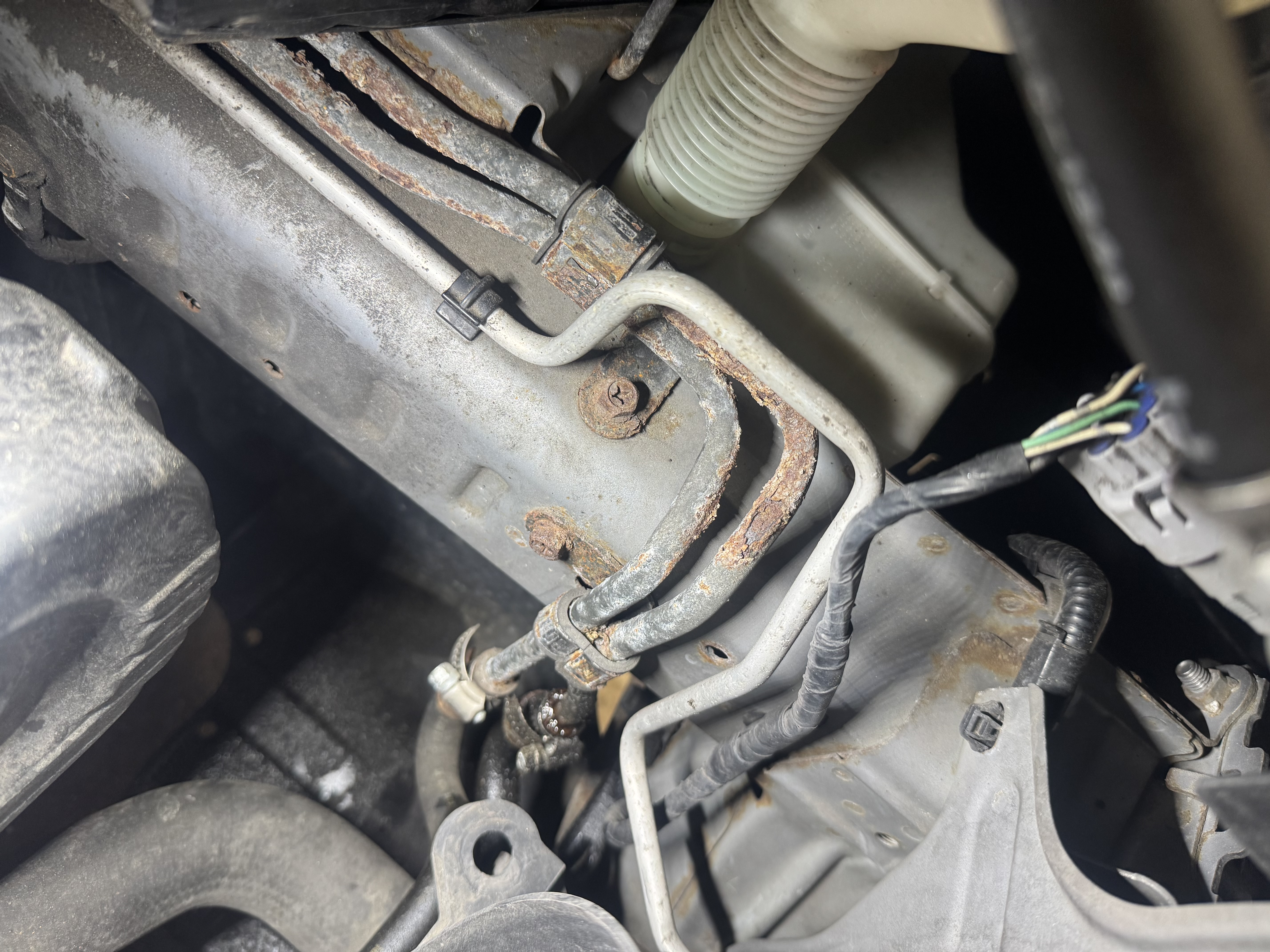
Leaking or rusty transmission cooler lines on your EJ Subaru? We diagnose and fabricate long-lasting replacements in Granby, CT. Serving Hartford County, Simsbury, Suffield, and nearby.
The EJ-era Subarus that built our shop’s reputation are getting old, and New England winters have not been kind to them. If you own an EJ-platform Subaru—Impreza, Forester, Legacy, Outback, or WRX built through the late 2000s—there’s a good chance your transmission cooler lines are original. After 15+ winters, we’re seeing an epidemic of rotted steel sections, swollen rubber, seized fittings, and sudden ATF leaks.
In our Granby, CT shop, we still love these cars. But with corrosion creeping under every clamp and bracket, the Subaru EJ transmission cooler lines have become a high-risk item. When these lines fail, they don’t whisper; they shout. ATF can gush out, the transmission starves, gears slip, and within minutes a healthy gearbox can turn into a very expensive rebuild. We also see ATF spraying onto hot exhaust, causing smoke and potential fire hazards.
The good news: the problem is preventable and fixable. The OEM lines are a mix of steel hardline and short rubber sections. Time, salt, and dissimilar metal corrosion eat them from the outside in—especially where the steel passes through plastic retainers on the subframe and along the lower radiator area. Once we identify the weak points, we can replace the entire run with corrosion-resistant lines, proper transmission-rated hose, and quality clamps so you can drive through many more winters with confidence.
This page explains what to watch for, how we diagnose Subaru EJ transmission cooler line problems, and how we repair them the right way for life in Hartford County and the surrounding towns.
Common signs your EJ Subaru’s transmission cooler lines are failing:
- Red or brown oily spots under the front of the car, especially near the passenger-side radiator area - Fresh fluid on the lower radiator support, crossmember, or splash shields - Burning oil smell or visible smoke after highway driving (ATF mist hitting the exhaust) - Transmission slipping, delayed engagement, or sudden flare on upshifts—often after a hot restart - Low ATF level on the dipstick (checked per Subaru procedure, engine running, warm, level surface) - Lines look scaly, wet, or swollen under clamps; rubber sections feel soft, mushy, or cracked - Fittings at the radiator look crusted, seized, or damp with reddish residue
If you notice any of these, park the car and call us. It doesn’t take much fluid loss to damage a 4EAT/5EAT. Prolonged driving on a leak can turn a relatively simple line replacement into a transmission overhaul.
How we diagnose EJ Subaru transmission cooler line issues at College Highway Auto:
1) Interview and baseline checks - We ask about recent symptoms, when they occur, and fluid history. We verify the exact model/engine/trans combination because Subaru used variations of cooler line routing and fittings across EJ years and trims. - We confirm the ATF type specified by Subaru for your transmission (most EJ 4EAT/5EAT use Subaru ATF-HP; we always verify by VIN).
2) Visual inspection on the lift - With belly pans removed, we inspect the hardline runs from the transmission to the radiator area, noting rust bloom under plastic clips and at bends. - We examine rubber sections for softness, cracking, or blistering—especially near heat sources and where clamps bite. - We check for ATF at the lower radiator tank and on the subframe. If fittings are fused with corrosion, we plan for controlled removal to avoid damaging the radiator’s integral cooler.
3) Confirming the fluid source - We verify the leaking fluid is transmission fluid (not engine oil or power steering). ATF is typically red to brown and slick, with a distinct odor. If the fluid is dark or smells burnt, we document it—it helps us understand transmission health.
4) System integrity checks - If the leak is slow, we may add UV dye to the ATF and run the engine to pinpoint the exact weep point. - We inspect the radiator’s internal ATF cooler for signs of cross-contamination. While internal cooler failures are rare on these Subarus compared to some other makes, we still check the coolant overflow and radiator neck for ATF sheen (“strawberry milkshake”) and ensure coolant hasn’t entered the ATF.
5) Related rust assessment - We assess the mounting points, brackets, and hardware for structural rust. On older EJ cars in New England, it’s common for fasteners and clip points to be compromised. Planning the job well up front prevents broken studs and repeated visits.
6) Report and plan - We provide photos and a clear estimate. If the radiator fittings are too corroded to save, we’ll discuss options (radiator replacement or a safe workaround) before any disassembly. We outline parts, fluid, and line fabrication choices so you can make an informed decision.
We won’t promise a quick clamp-and-go patch on lines that are clearly at the end of their life. Temporary patches on rotted steel are risky and can fail without warning, so our goal is to restore reliability—not just stop today’s drip.
What a proper EJ Subaru transmission line repair looks like in our Granby shop:
1) Clean disassembly - We pre-soak fittings and clamps, use heat where safe, and protect the radiator tanks to avoid cracking plastic. If a fitting is too far gone, we’ll remove the radiator in a controlled manner rather than twist a brittle nipple off and escalate the repair.
2) Remove the entire compromised run - On rust-belt Subarus, failure in one section means the rest isn’t far behind. We remove both supply and return lines from the transmission to the cooler, including any corroded brackets or clips that trap moisture.
3) Fabricate corrosion-resistant hardlines - We build new lines using copper-nickel (NiCopp) tubing for its superior corrosion resistance and formability. We route them along the OEM path, away from heat and moving components, and add abrasion sleeves where needed.
4) Use the right hose and clamps - Where flexible sections are required, we only use transmission-cooler-rated hose (SAE J1532 or equivalent), not generic fuel or vacuum hose. We crimp or clamp with high-quality constant-tension or fuel-injection–style clamps that maintain pressure through heat cycles—no hardware store worm clamps on critical ATF circuits.
5) Refresh seals and fittings - We replace O-rings, sealing washers, and any suspect quick-connects. If the radiator’s internal cooler is compromised or fittings are unsafe to reuse, we recommend radiator replacement or an auxiliary cooler solution appropriate for your model and usage.
6) Fluid service and verification - We refill with the correct Subaru-specified ATF for your transmission. When contamination or severe overheat is suspected, we perform a multi-stage fluid exchange to dilute old fluid while avoiding shock to the clutch packs. We do not blindly “power flush.” - We warm the car, check level per factory procedure, and road-test while monitoring transmission temperature and behavior.
7) Rust protection and longevity - We coat new hardlines and brackets with corrosion inhibitor. On request, we can apply additional rust protection to nearby subframe and mounting points to slow future corrosion.
8) Final quality checks - We re-check cold and hot for weeps. We confirm there’s no hose chafe, no contact at full steering lock, and that all retainers are secure.
Why we don’t do partial patches on rotted EJ lines - If a single rust blister has burst, the rest of the line has been marinating in salt for the same number of winters. We see too many “one clamp and two inches of hose” patches come back on a tow truck. A comprehensive line replacement costs less than a transmission.
Turnaround time and parts sourcing - Most EJ Subaru transmission line repairs are same-day once parts and tubing are on hand. When radiator replacement is required (due to seized/corroded fittings or internal cooler concerns), we’ll advise the added time upfront. We stock the right ATF and keep NiCopp tubing, quality clamps, and transmission-rated hose ready for these cars.
Transmission fluid is the lifeblood of your EJ Subaru’s 4EAT/5EAT. When cooler lines leak, the transmission loses lubrication and hydraulic pressure. Shifts become erratic, heat skyrockets, and internal clutches glaze and burn. A fifteen-dollar clamp or a corroded steel section shouldn’t be the reason a solid Subaru needs a new gearbox.
In Hartford County—and especially in towns like Granby, East Granby, Simsbury, Suffield, and into Southwick over the Massachusetts line—road salt and moisture make this a predictable failure. Replacing the lines proactively or at the first sign of seepage is inexpensive insurance. Done correctly with corrosion-resistant materials, the repair can outlast the rest of the car.
It’s also a safety and environmental issue. ATF dripping onto exhaust can smoke heavily and, in extreme cases, ignite. Leaks also leave slick spots on your driveway and the road. Fixing the lines protects your transmission, your safety, and your neighbors’ roads.
We see issues across EJ-equipped Impreza, Forester, Legacy, Outback, and WRX models built roughly from the late 1990s through the late 2000s. The problem is worse on cars that lived in New England due to road salt and moisture. Lines corrode near plastic clips, along the lower radiator area, and under clamps where grime traps moisture.
Transmission fluid (ATF) is typically reddish to brown and slick with a distinct smell, and it often appears at the front passenger side near the radiator on EJ Subarus. Engine oil is darker and tends to collect lower on the oil pan and crossmember. Power steering leaks usually appear higher up under the pump or along the return hose. We can quickly confirm the source on a lift and, if needed, use UV dye to pinpoint the origin.
We avoid partial patches on rotted lines. If the steel sections are scaly or wet, the rest is close behind. Replacing only a short section often leads to sudden failure elsewhere. Our standard is to replace the full run with corrosion-resistant hardline (NiCopp) and proper transmission-rated hose to restore reliability.
We use a mix. Where OEM assemblies make sense and are available, we’ll use them. In many rust-belt cases, custom NiCopp hardlines offer better long-term corrosion resistance and allow us to route around compromised mounting points. We always use transmission-cooler–rated hose and quality clamps for flexible sections.
We verify the exact fluid by VIN. Most EJ 4EAT and 5EAT applications take Subaru ATF-HP, but we confirm to avoid mixing specifications. After repairs, we follow Subaru’s warm, level, engine-running procedure to set the fluid level correctly and road-test while monitoring transmission temperature and behavior.
If fluid looks clean and the leak was caught early, a drain-and-fill may be sufficient. If the fluid is burnt or contaminated, we perform a controlled multi-stage exchange to gradually refresh the ATF. We don’t do aggressive power flushing that can dislodge debris suddenly. The decision is based on inspection and test results.
Sometimes, yes. If the cooler fittings are seized or the integral cooler shows signs of internal issues, replacing the radiator is the safest route. We’ll inspect carefully before removal, discuss options upfront, and only recommend replacement when we can’t guarantee a safe, leak-free connection.
Most EJ Subaru transmission line replacements are same-day repairs. If seized fittings or radiator replacement are involved, it can extend the timeline. You’re welcome to wait in our lobby for shorter jobs, but we’ll give you a realistic time estimate after inspection so you can plan your day.
We don’t recommend it. Even slow leaks can suddenly worsen, and ATF loss can damage the transmission within minutes. ATF on the exhaust can also cause heavy smoke and potential fire risk. If you see red drips or smell burning fluid, it’s best to park the vehicle and have us inspect it.
Periodic inspection is key. Have the lines, clamps, and radiator fittings checked at each service, especially after winter. Rinsing the underside in spring helps remove salt. Replacing heavily corroded lines proactively with NiCopp and quality hose/clamps is the most reliable long-term solution for New England cars.