Rear wheel bearing noise on a Subaru Outback? College Highway Auto in Granby, CT diagnoses and replaces seized, rusty hub bearings the right way. Book today.
A 2017 Subaru Outback with around 80,000 miles rolled into College Highway Auto here in Granby, CT with a deep rear-end hum that grew louder with speed. The owner described a low roar that changed slightly when they drifted the steering wheel on the highway. Classic symptom set—but we never guess. We diagnose first. In the northeast, rear wheel bearings can be stubborn and corrosion-prone, and this generation Outback’s rear hub assembly can put up quite a fight when road salt has had a few winters to do its thing. It’s one of those jobs that looks straightforward on paper but often turns into a rust-belt reality check.
If you’re in Hartford County—Granby, East Granby, Suffield, Simsbury, Windsor Locks, or even Southwick over the line in Massachusetts—you’ve likely heard that same telltale growl. A worn rear wheel bearing is more than an annoyance. Left unaddressed, it can damage the wheel speed sensor, overheat the hub, and in extreme cases affect braking and stability control performance. That’s why we take a methodical approach: confirm the noise source, rule out tire issues, verify the bad bearing, and then remove and replace it without collateral damage to the parking brake hardware, ABS sensor, tone ring, or suspension alignment.
We’ll walk you through the symptoms to watch for, how we separate a bad bearing from tire or differential noise, why the repair in the northeast can be a knuckle-buster for DIYers, and what it takes to do the job correctly on a 2015–2019 Subaru Outback. No scare tactics, no parts-cannon—just professional diagnosis and repair from your local Granby shop.
Rear wheel bearings typically fail progressively. On a Subaru Outback, the early warnings are subtle and easy to miss, then they grow more persistent:
- A steady humming, droning, or roaring that increases with road speed. Many drivers notice it most between 35 and 65 mph. - The pitch or volume changes when loading the vehicle side-to-side—like when you steer gently left or right on a highway sweep. Load the bad side and the noise often gets louder. - A vibration that feels like coarse pavement through the floor or seat, even on smooth roads. - In advanced cases: heat at one rear hub after a longer drive, or a faint burnt smell near that wheel. - Possible ABS warning light or stability control light if the wheel speed sensor signal becomes erratic due to bearing play or encoder damage (the magnetic tone ring is integrated into the hub assembly).
Common lookalikes that trick folks into replacing the wrong part:
- Cupped or feathered tires that create a rhythmic droning very similar to a bearing. Rotating tires front to rear can change the noise and lead you astray. - Rear differential whine, which usually changes more with throttle/decels than with steering load. - Worn rear brake hardware or a stuck parking brake shoe lightly rubbing the inside of the rotor hat.
If you’re hearing a roar and aren’t sure where it’s coming from, don’t guess. Correct identification saves money and avoids repeat work.
We start with a conversation and a controlled road test on familiar Granby-area routes where we can safely load the chassis and vary speeds. The goal is to distinguish wheel bearing noise from tires or drivetrain.
Our diagnostic routine on a 2017 Subaru Outback typically includes:
- Steering sweep test at speed: We gently veer left and right within the lane. If the noise grows when we load the right side, the right rear bearing is suspect; load the left side and the left rear may be the culprit. This is a guide, not a verdict. - Tire evaluation: We measure tread depth across each tire, feel for cupping and stepped wear, and check pressures. Uneven tires can mimic a bearing. If needed, we swap front/rear or install known-good wheels to see if the noise follows the tires. - Lift inspection and spin test: With the car safely lifted, we check each rear wheel for roughness by spinning by hand and listening through a mechanic’s stethoscope or chassis ears at the knuckle. We also feel for play at 12 and 6 o’clock. Excessive play isn’t always present on modern hub units, but a gritty, notchy feel or audible growl is a strong indicator. - Infrared temperature comparison: After a consistent road test loop, we quickly check hub temperatures. A failing bearing often runs hotter than its counterpart. - Scan tool data: We look at live ABS wheel speed signals while driving. A noisy or failing bearing can create a choppy or inconsistent signal at certain speeds long before a warning light appears. - Brake and parking brake check: Since Subaru rear rotors house the parking brake shoes inside, we verify the shoes aren’t dragging, delaminating, or contacting hardware that could produce a similar noise.
Only after we’ve confirmed the source do we recommend replacement. We never advise replacing both sides “just because.” While it’s true that New England road salt ages components in pairs, we let testing lead the repair. In this Outback’s case, the right rear hub bearing growled on the stethoscope, ran hotter by comparison, and the noise clearly changed when loading that side. Diagnosis confirmed: right rear hub bearing failure.
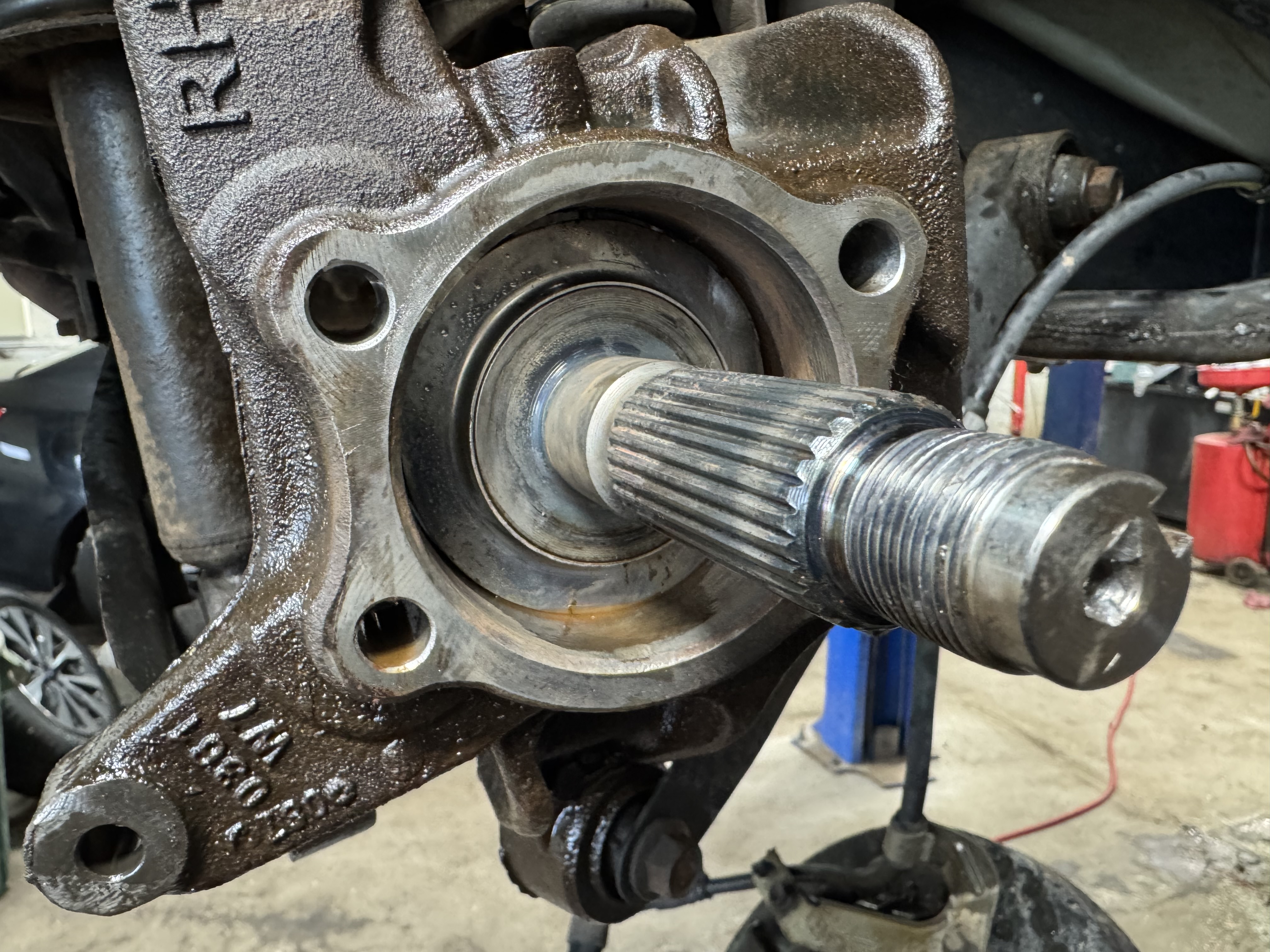
On paper, the 2015–2019 Subaru Outback uses a bolt-in rear hub bearing assembly. In practice, Hartford County winters often weld that hub to the aluminum knuckle with corrosion. That’s why we plan the job with the right tools and patience.
Preparation and protection:
- Battery and electronics are safe, car is on a lift, and we disconnect the wheel speed sensor from the harness to protect it. Subarus use a magnetic encoder ring in the hub—keep metal filings and harsh impact away from it. - We remove the caliper and bracket, secure them to avoid hose strain, and take off the rotor while minding the parking brake shoes and hardware. This is a great time to inspect shoe lining thickness and the hold-down springs. - The axle nut is unstaked, removed, and we check the axle splines for corrosion. If needed, we apply penetrant and use a pusher tool to avoid hammering on the axle and damaging the CV joint.
Freeing the seized hub:
- The hub is retained by four bolts accessed from the back of the knuckle. On rust-belt cars, those bolts, the hub flange, and the knuckle bore can seize. We apply penetrating oil days in advance when possible, then use heat judiciously and corrosion-specific tools. A slide hammer, hub puller, or a dedicated hub tamer system helps coax the bearing out without cracking the knuckle. - If the hub refuses to budge—and this is not uncommon—we may remove the knuckle assembly and press the hub out on the bench. In severe cases, we plan for replacement fasteners and, if necessary, a new dust shield or ABS sensor if corrosion has already compromised them.
Cleaning and assembly:
- Once the old hub is out, we thoroughly clean and lightly dress the knuckle bore to remove scale and corrosion. A thin, appropriate anti-seize or rust-inhibiting layer on the mating surface helps the next tech (and future you). - We install the new quality hub assembly, aligning it carefully so as not to nick the encoder ring. The mounting bolts are torqued to Subaru specification in a crisscross pattern. - The axle nut is replaced with a new stake nut and torqued to factory spec with a calibrated torque wrench. We never rely on an impact for final torque. - Parking brake shoes are adjusted to proper drag with the rotor hat installed, then we reassemble the caliper and bracket, inspect pads and rotor thickness, and verify freewheel movement. - The ABS sensor is cleaned, reinstalled, and its harness routing double-checked to prevent chafe. We clear any stored ABS codes and recheck live data.
Quality check and road test:
- With the wheel back on and torqued properly, we perform a careful road test on varied surfaces at neighborhood speeds and highway speeds around Granby and East Granby. The previous roar should be gone. We confirm quiet operation during steering sweeps and monitor ABS data for a stable signal. - If suspension arms or toe links had to be loosened to access stubborn fasteners—a real possibility on northeast cars—we recommend a four-wheel alignment. Any time toe or camber eccentrics are disturbed, an alignment ensures tire life and proper handling.
Why this is a tough DIY in the northeast:
- Corrosion is the wild card. Even with heat, penetrants, and the right pullers, it takes experience to get the hub out cleanly without damaging the knuckle, parking brake shoes, or ABS sensor. Fasteners can snap; wheel speed sensors can seize in the knuckle. Having replacement hardware and the ability to press components on the bench is often what separates a smooth repair from a multi-day project.
At College Highway Auto, we plan for the worst, hope for the best, and deliver a quiet, safe result. This Outback left with a new rear hub, intact parking brake, a happy ABS sensor, and silence from the back of the car.
A failing rear wheel bearing isn’t just noisy. As the bearing deteriorates, heat builds, grease breaks down, and play can develop. That extra movement can:
- Distort the encoder signal the ABS and stability control rely on, potentially triggering warning lights or reducing system effectiveness in hard stops or slick Hartford County winters. - Create uneven brake pad deposits or hot spots on the rotor if the wheel wobbles ever so slightly. - Increase rolling resistance, trimming fuel economy and stressing the hub, CV axle, and even tires.
In extreme, ignored cases, a bearing can seize or come apart internally. That is rare but serious. More commonly, drivers put up with the noise for months and end up paying more when the heat and vibration take out the ABS sensor or parking brake hardware. Fixing the right thing at the right time saves money and keeps your Outback confident on Granby’s back roads and I-91 runs.
A steady hum or roar that gets louder with speed, a change in tone when you steer gently left or right at highway speeds, a gritty feel when spinning the wheel in the air, and in some cases heat at one hub. An ABS light can also appear if the encoder signal becomes erratic.
We road test with controlled steering sweeps, inspect for cupped or feathered tread, check and adjust tire pressures, and, if needed, rotate or use known-good wheels to compare. On the lift, we listen at the knuckle with a stethoscope or chassis ears, compare hub temperatures after a drive, and review live ABS wheel speed data. We don’t guess—we confirm.
Short, gentle drives may be possible, but we don’t recommend delaying. As the bearing worsens it can overheat, damage the ABS sensor, increase stopping distances on rough roads, and in severe cases fail. In Hartford County’s winter conditions, stability control performance matters—schedule a prompt inspection.
Not automatically. We replace the failed side once diagnostic testing confirms it. That said, northeast corrosion and similar mileage can age parts in pairs. We’ll inspect the opposite side, share our findings, and let the data guide the decision.
Often no, but it depends. If we had to loosen or remove rear suspension arms or toe/camber eccentrics to battle corrosion and access fasteners, we recommend a four-wheel alignment. If only the hub assembly was changed and no alignment points were disturbed, an alignment may not be necessary.
Road salt and moisture corrode the hub to the knuckle, seize fasteners, and can fuse ABS sensors in place. Removal may require heat, pullers, or even removing the knuckle for bench pressing. Planning, patience, and the right tools make all the difference.
On a clean, rust-free vehicle, a few hours is typical. In the Granby, CT area, corrosion can extend the job if the hub is seized or hardware breaks. We keep you updated with realistic timelines based on what we find.
It can. The hub contains a magnetic encoder ring for the wheel speed sensor. Excess play or heat can distort the signal. We always verify sensor function and wiring during the repair and correct any related issues.
We check the parking brake shoes and hardware inside the rear rotors, brake pad and rotor condition, the ABS sensor and harness, axle splines, and the knuckle bore. If any parts are borderline or damaged by corrosion, we’ll review options with you before proceeding.
We install quality, proven hub assemblies that meet or exceed OEM performance, and we stand behind our work. If you prefer OEM, we’re happy to source Subaru-branded parts. In either case, correct installation and torque are critical to long life.