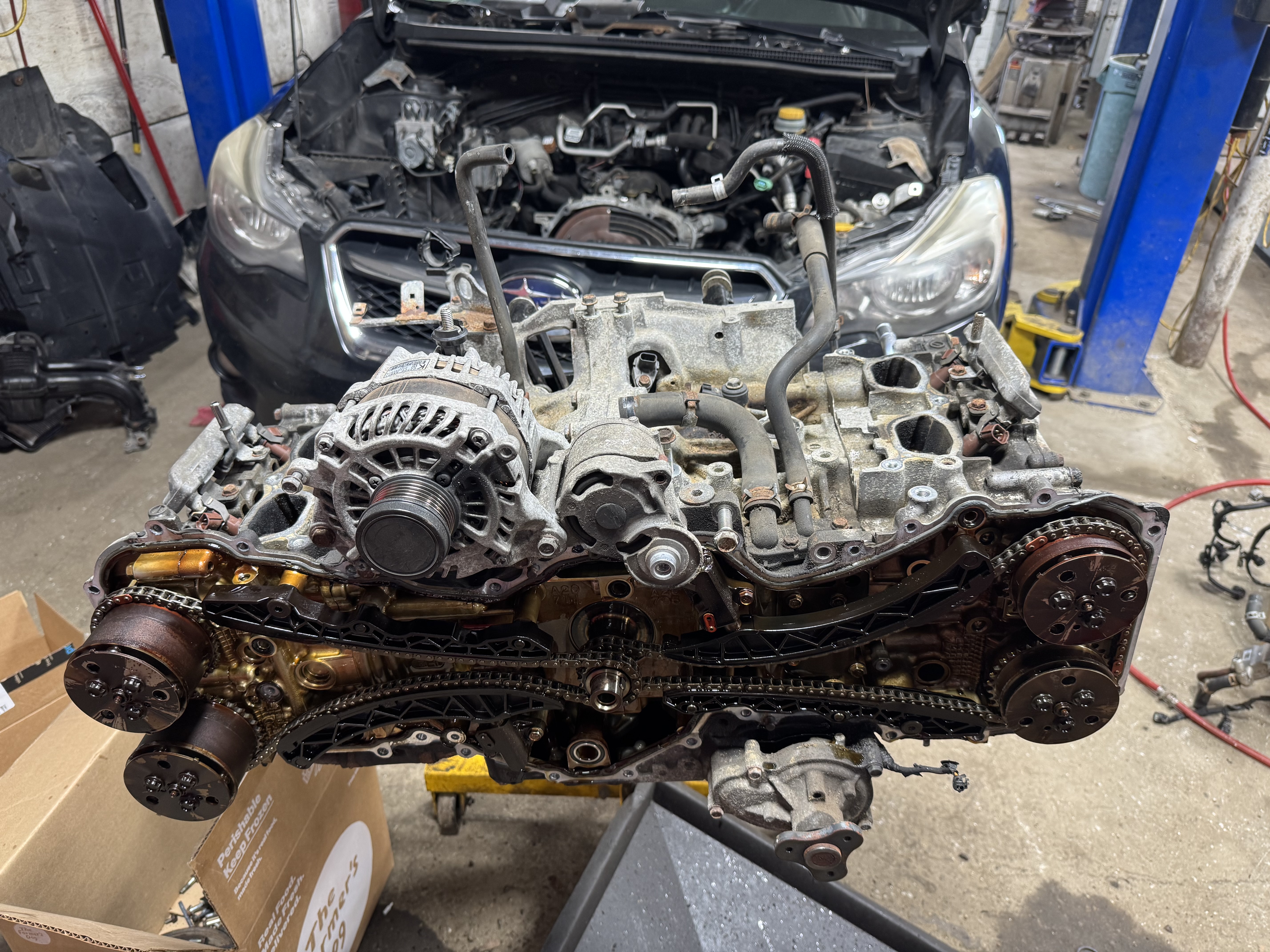
Oil and coolant mixing on a Subaru Crosstrek (FB20)? In Granby CT, we diagnose before we reseal. Common culprit: upper oil pan sealing. Full synthetic 5W-30, 3k OCIs.
If you popped the hood on your Subaru Crosstrek and found a chocolate-milk look in the coolant bottle or a greasy sheen floating in the radiator, your gut reaction is probably, “Head gasket.” But on many FB20 2.0L engines, especially those living long lives with extended oil change intervals, the culprit we find in our Granby, CT shop is different: upper oil pan sealing that has hardened and started to leak internally.
At College Highway Auto, we see a steady stream of Crosstreks and other Subaru FB-series engines from Granby, Simsbury, East Granby, Suffield, Southwick, and across Hartford County with oil/coolant intermix concerns. We don’t guess. We test, verify, and then repair what’s actually failed. In this case study, we’ll walk through the symptoms, how we diagnose intermix, why these engines are prone to upper oil pan sealing issues when oil is run too long, and how we reseal and protect the engine going forward.
On the vehicle featured here, extended oil change intervals had taken their toll. The upper oil pan sealing had begun to fail, allowing oil and coolant to cross-contaminate. After confirming the fault, we performed an engine reseal and set the customer up on 3,000-mile oil changes using full synthetic 5W-30 to help keep the FB20 clean and protected.
Here are the most common signs we see when oil and coolant start to mix on a Subaru Crosstrek FB20 engine:
- Coolant reservoir or radiator shows a brown/tan "milkshake" appearance - Oily sheen visible on the coolant surface or residue in the overflow bottle - Cooling system hoses feel unusually soft or swollen over time - Heater performance is inconsistent or has a sweet/oily odor - Engine oil level creeping up (dilution) or oil looks abnormally thin or discolored - Low coolant with no obvious external leaks - Cooling system pressure rises faster than normal after startup - Check engine light may be off, but misfire or roughness can appear cold
Not every vehicle presents all of these. Some Crosstreks show only a faint sheen in the bottle; others arrive on a tow truck with overheating. Either way, don’t assume a head gasket or an oil cooler is the issue until proper testing is done.
Our approach at College Highway Auto is methodical and non-invasive to start. Before recommending a repair, we confirm where the fluids are crossing.
Initial inspection and history - Interview: We ask about oil change intervals, oil grade used, top-off habits, and any recent overheating. Extended intervals are a red flag for upper oil pan sealing on FB20s. - Visual check: We inspect the coolant reservoir, radiator neck, and oil cap for emulsified residue. We also look for external leaks around the oil cooler area, timing cover, and the pan seam.
Fluid testing - Coolant sample: We draw a small coolant sample and check for hydrocarbons and oil droplets under light. A lab test (if needed) can quantify oil in the coolant. - Engine oil inspection: We look for coolant traces in the oil (milky buildup on cap or dipstick) and may send an oil sample for analysis if the signs are subtle.
Pressure and sealing tests - Cooling system pressure test: We pressurize the cooling system cold and look for pressure decay with no external drips. We monitor the crankcase for any pressure change. - Crankcase pressure/leak-down: Cylinder leak-down testing helps rule out cylinder-to-coolant breaches. While head gaskets are often blamed, many FB20s pass leak-down perfectly and still have intermix due to sealing elsewhere. - Block test: If combustion gases are suspected in the coolant, we perform a block test. Many FB20 intermix cases show no combustion gases, further pointing away from head gaskets.
Targeted FB20 checks - Upper oil pan seam: On FB engines, the upper oil pan and related RTV-sealed interfaces are known to harden when oil is run too long or overheated. We check for oil seepage and staining along the pan-to-case seam and timing cover area. - UV dye: With consent, we add UV dye to the oil or coolant and re-test after a short run to see if any crossover tracks can be identified externally. This sometimes reveals subtle case seam weeping. - Borescope where practical: We may scope the coolant passages and oil return areas (where accessible) for evidence of emulsification.
Why we don’t jump to the oil cooler or head gasket - FB20 Crosstreks do not commonly fail at the oil cooler to cause bidirectional oil/coolant intermix. It’s not impossible—but it’s not our first suspect. - Classic EJ-series head gasket failures aren’t a 1:1 comparison for FB engines. While head gaskets can fail, most intermix cases we see locally track back to upper oil pan/timing case sealing on high-mile or extended-interval engines.
Outcome on this vehicle - Tests ruled out combustion gas intrusion and showed no external leaks. The pattern, history of long oil change intervals, and inspection findings pointed to hardened upper oil pan sealing allowing fluids to cross-contaminate. With the failure mode verified, we recommended an engine-out reseal of the affected interfaces.
Once testing confirms the sealing failure, we outline the repair plan, parts, and expected timeline with the customer. We do not quote blindly; our estimate is based on findings from the diagnostic steps above.
What an FB20 reseal typically involves - Engine removal: Working on these sealed interfaces is far cleaner and more precise with the engine out. It lets us prepare the surfaces to a like-new finish. - Upper oil pan reseal: We remove the upper oil pan assembly, clean all mating surfaces to specification, and reseal with the correct OE-style sealant. We also replace related O-rings and gaskets that interface with oil and coolant passages. - Timing/front cover inspection and reseal as needed: If inspection shows RTV aging at the timing cover or intersecting passages, we address those while the engine is out. Catching it now prevents future leaks. - Oil cooler and gasket inspection: While not the common cause on these, we inspect and replace the cooler gasket if there is any doubt. We do not upsell parts; we replace only what testing and inspection justify. - System cleaning: Oil in the cooling system must be removed thoroughly. We perform multiple coolant flushes with a detergent approved for cooling systems, then refill with the correct Subaru-spec coolant. The engine oil and filter are replaced, often twice in short succession, to ensure any residual moisture is removed. - Thermostat and hoses: We test and inspect. If oil contamination has noticeably softened hoses or compromised the thermostat, we’ll recommend replacement with your approval.
Quality control checklist - Surface prep verification: All sealing surfaces are checked for flatness and cleanliness; sealant bead profile and cure times are followed per manufacturer specs. - Pressure tests after assembly: Cooling system and oil system are pressure-tested before the first start. - First start and heat cycles: We complete several controlled heat cycles and recheck for seepage or pressure anomalies. - Post-repair flush plan: We schedule a follow-up oil and filter change after a short interval to catch any remaining moisture, plus a coolant check.
Oil choice and service intervals going forward - This Crosstrek left with fresh full synthetic 5W-30 and a 3,000-mile oil change interval. In our experience here in Granby and Hartford County—real driving, real weather—short, consistent intervals keep the FB20’s internal seals healthier and prevent the varnish and acid build-up that harden RTV sealing surfaces. - Extended oil change intervals contributed to the failure we found. We do not recommend extended intervals on these engines.
Timing, cost, and warranty - Typical turnaround for an FB20 engine-out reseal with system cleaning runs a few days, depending on parts availability and the amount of flushing required. - Costs can vary based on how far we need to go into the front cover and what we find on inspection. After diagnostics, we provide a written estimate so there are no surprises. - We stand behind our workmanship. Ask us about our repair warranty terms for reseal work.
Result on this vehicle - After resealing the upper oil pan interfaces and addressing aged sealant at related areas, we flushed the cooling system thoroughly, changed the oil and filter, and road-tested. No pressure creep, no intermix return, stable temperatures. We scheduled the owner for a 500–800 mile follow-up oil and filter and put them on a consistent 3,000-mile 5W-30 synthetic plan.
Oil and coolant are both lifeblood fluids. When they mix, the risks escalate quickly:
- Bearing damage: Coolant in oil destroys the oil film that protects crankshaft and cam bearings, accelerating wear. - Overheating: Oil in coolant reduces its heat transfer, potentially overheating the engine and causing further damage. - Seal degradation: Contaminated fluids can attack seals and hoses, multiplying leaks. - Sludge formation: The milkshake you see is just the start; inside, it can clog small passages and heater cores.
Catching intermix early and fixing the true cause prevents engine failure and preserves the vehicle you rely on to commute across Granby, run errands in Simsbury, or take weekend trips across Hartford County. The right diagnosis matters—because replacing the wrong parts wastes time and money, and the problem keeps coming back.
While head gaskets get the blame online, a common cause we see in Granby CT is hardened RTV sealing at the FB20’s upper oil pan and related interfaces, especially on vehicles with extended oil change intervals. As the sealant ages, it can allow oil and coolant passages to cross-contaminate. We confirm with testing before recommending a reseal.
It’s risky. Oil in coolant reduces the cooling system’s effectiveness and can lead to overheating. Coolant in oil can damage engine bearings. Short local trips to our shop may be okay if temperatures stay normal, but we recommend limiting driving and scheduling a diagnosis quickly.
We use a combination of tests: cooling system pressure tests, cylinder leak-down, and, if needed, a chemical block test for combustion gases. Many FB20 intermix cases show no combustion gases in the coolant and pass leak-down, pointing away from the head gasket and toward sealing at the upper oil pan/timing case interfaces.
After confirming the fault, we typically remove the engine, reseal the upper oil pan with the correct sealant, address any aged sealing at related interfaces, inspect the oil cooler gasket, and perform thorough coolant system flushing. Fresh oil and filter are installed, with a follow-up oil change scheduled to remove any residual moisture.
Most FB20 reseal and flush jobs take a few days, depending on parts availability and how contaminated the system is. We provide a written estimate and timeline after diagnostics so you know what to expect.
Costs vary with the exact failure point and how deep we need to go (upper oil pan only versus also addressing front cover areas). After testing, we’ll give you a precise estimate. We don’t replace parts without cause, and we’ll show you our findings.
No. Flushing removes contamination, but if oil and coolant are mixing due to a sealing failure, the intermix will return. The underlying seal issue needs to be repaired, then the system flushed thoroughly.
We recommend full synthetic 5W-30 and 3,000-mile intervals for FB20 engines in our climate and driving conditions. Short, consistent intervals help keep internal surfaces clean and reduce the seal hardening that leads to intermix issues.
Not in our experience. We do inspect the cooler and its gasket, but on FB20 Crosstreks with intermix, the more common root cause we diagnose is hardened upper oil pan or related RTV-sealed interfaces—not the cooler.
Yes. We stand behind our reseal work. Warranty terms depend on the scope of the job and parts used; we’ll provide the details with your written estimate.