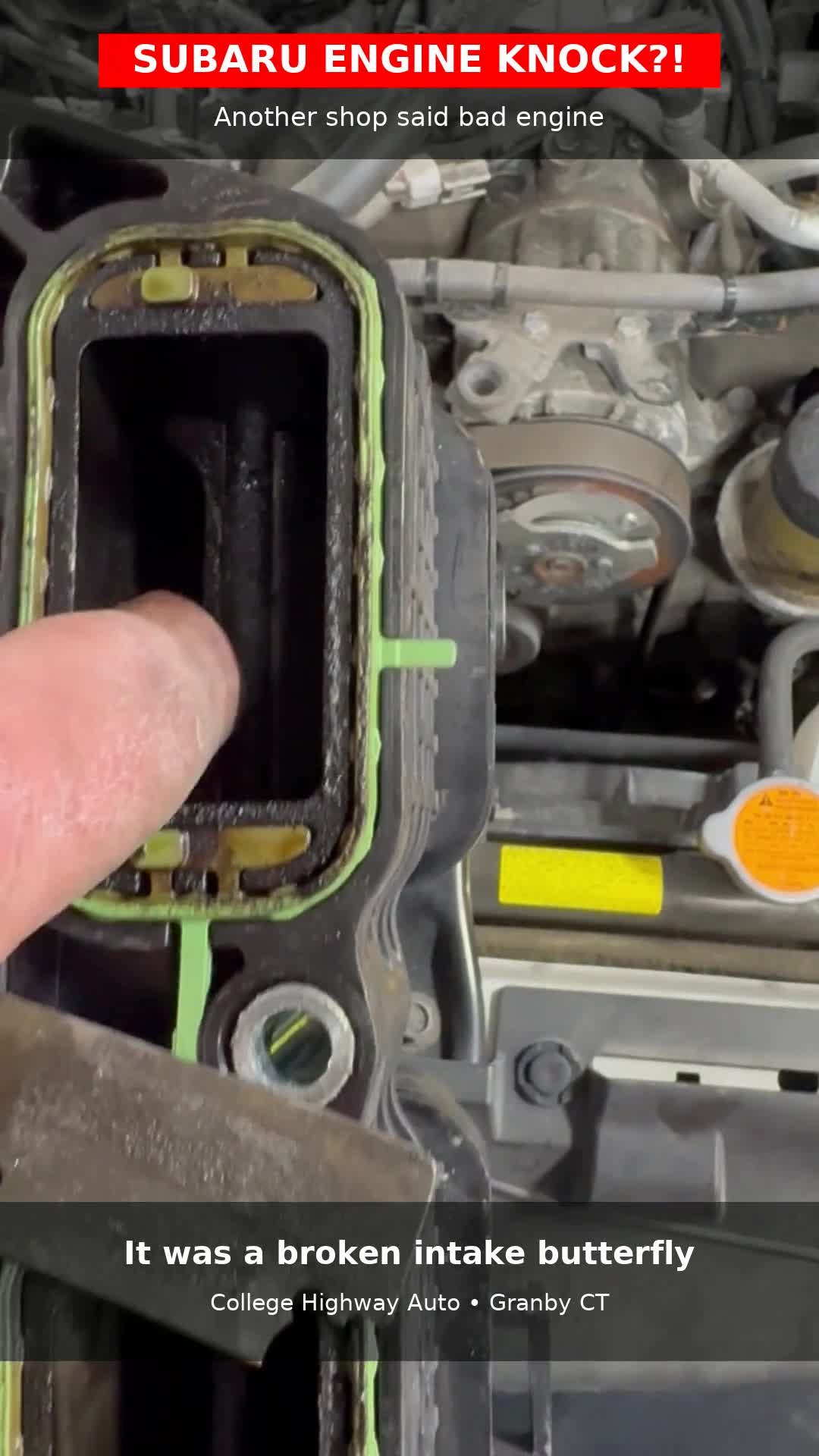
Subaru knocking? Before you buy an engine, get a real diagnosis. Our Granby CT shop found a loose intake butterfly on a 2019 Forester—no engine needed.
When a Subaru starts knocking, it’s easy to fear the worst. Rod knock. Spun bearing. New engine. We get it—those are expensive words. But not every knock means your engine is done. Case in point: this 2019 Subaru Forester brought to College Highway Auto in Granby, CT, after another shop had already condemned the engine.
Instead of green-lighting a replacement long block, we listened—literally. The sound wasn’t acting like bottom-end knock. After a focused diagnosis, we found a broken intake butterfly and another one so loose it was slapping back and forth whenever manifold vacuum changed. That “engine knock” was an intake hardware failure, not a death sentence.
If you’re in Granby, Hartford County, or nearby towns like Simsbury, East Granby, Southwick, or Suffield, and your Subaru is making a scary noise, get a second opinion from a shop that actually tests before replacing. Here’s how we tracked this one down and what it means for your Subaru.
What this Forester owner heard sounded like a dull tapping that came and went. It was most noticeable at idle or during quick throttle transitions (on and off the gas). That pattern matters—true rod knock usually grows louder with load and RPM in a predictable way. Intake-related noises tend to follow changes in manifold vacuum and airflow.
Common signs your Subaru’s knock might not be a bad engine: - The tap/clatter changes instantly when you crack the throttle, then quiets as RPM stabilizes. - Noise seems to come from the intake side more than the oil pan area. - No metallic glitter in the oil, and oil pressure looks normal. - The engine runs fairly smoothly otherwise, maybe with a slight stumble cold. - You might see pending or stored intake runner/tumble valve codes (P2004–P2008, P2016–P2017), but not always.
On this 2019 Forester (FB25 engine), the intake manifold uses internal valves (often called tumble generator valves or intake runner flaps) that can fail. If a butterfly plate loosens or breaks, it can rattle on vacuum changes and sound a lot like a mechanical engine knock.
We never call an engine without evidence. Our process on this Forester combined ears, data, and inspection:
1) Interview and baseline - We confirmed the customer complaint, asked when the noise started, and noted when it was most obvious. - We verified maintenance history and any previous work. Extended drain intervals and varnish can make intake hardware sticky, so history matters.
2) Listen with intent - With the engine warm, we listened with a mechanic’s stethoscope at several points: valve covers, front timing cover, oil pan, intake plenum, and high-pressure fuel pump area. The sharpest resonance was on the intake manifold, not the oil pan. That’s an early clue against bottom-end knock. - We studied how the sound changed: distinct during tip-in/tip-out, calmer at steady RPM. Rod bearing knock typically intensifies with load and can follow a consistent beat with RPM. This noise didn’t behave that way.
3) Scan data and functional checks - We scanned the ECU for codes and mode 6 data. No hard fault for runner control was stored, but short-term fuel trims twitched with the noise and idle. That suggested airflow inconsistency rather than internal bearing clearance. - We graphed MAP (manifold absolute pressure) against throttle changes and confirmed that the knock lined up with big vacuum swings. - We commanded EVAP purge and other actuators to see if the noise could be influenced. No change with purge or A/C load increases, but quick throttle blips from closed to slightly open consistently triggered the clatter.
4) Visual access and borescope - After smoke-testing the intake (no external vacuum leaks found), we removed the air ducting to look inside the throttle body and intake plenum with a borescope. - We discovered one intake butterfly plate out of position—its retaining hardware had failed. Another plate was loose on its shaft. The loose plate was free to tap the housing under changing vacuum.
5) Safety verification - Before any startup after disassembly, we accounted for all hardware. Loose screws on intake butterflies can get sucked into a cylinder and cause expensive damage. We confirmed none were missing into the runners. If anything is unaccounted for, we borescope the cylinders before cranking.
6) Oil and metal check - We inspected the oil for glitter with a bright light and a magnet. Clean. Oil pressure was normal. These checks supported our finding that the long block was healthy.
At this point, we had a solid root cause: damaged intake butterfly hardware inside the manifold creating a knock-like rattle during vacuum transitions. No engine replacement needed—just proper intake manifold repair with the right parts and procedures.
We addressed the intake hardware the correct way—methodically and with OEM-quality parts.
1) Intake manifold removal and inspection - We removed the intake manifold to access the runner control assemblies. On the FB25, this requires careful handling of fuel, EVAP, and PCV connections. - We inspected every butterfly plate, shaft, bushing, and fastener. One plate was broken; another was loose on the shaft. We checked for wear in the shaft bores and binding points that could cause repeat failure.
2) Hardware and component replacement - We replaced the damaged butterfly assembly and its hardware. Where Subaru specifies peened or thread-locked screws, we followed factory strategy to ensure screws cannot back out. - We replaced intake manifold gaskets and any disturbed O-rings. Reusing gaskets on these plastic/composite manifolds is a recipe for vacuum leaks and unstable trims. - If runner control actuators or position sensors show out-of-spec readings during testing, we replace those only after confirming failure. In this case, the actuator operated normally once the mechanical issue was corrected.
3) Debris control and cylinder protection - We inspected each runner and intake port for foreign material. Any signs of missing hardware trigger a borescope check of the cylinders before reassembly. You never want to start an engine that might have ingested a screw. Fortunately, all hardware was accounted for on this Forester.
4) Reassembly, torque, and relearns - We reinstalled the manifold, torqued fasteners in sequence, and reconnected all lines and sensors. - Battery was stabilized to preserve learned trims where appropriate; after repair, we performed an idle relearn and verified fuel trims at hot idle and under light cruise. - We cleared any adaptive values that could mask new data, then road-tested.
5) Verification drive and final checks - On the test drive, we purposely created the conditions that previously provoked the noise—quick throttle on/off, parking lot maneuvers, and gentle uphill load. The clatter was gone. - We rescanned for pending faults, checked long- and short-term fuel trims, and verified smooth operation of the intake runner controls. Everything checked out.
6) Preventive guidance - Sticky or worn intake parts can be made worse by varnish and carbon. We recommended timely oil service with full synthetic 5W-30 and conservative 3,000-mile intervals to keep the PCV and intake systems clean on these engines. We also discussed air filter condition and periodic intake tract inspection to catch early signs of hardware wear.
Why we don’t just throw parts - We’ve seen too many Subarus misdiagnosed with “rod knock” when the noise is from the intake, an accessory, a timing guide, or even the purge or high-pressure pump. Replacing an engine without confirming the failure is expensive and unnecessary. A methodical diagnosis saved this customer thousands of dollars and weeks of downtime.
A wrong call on engine noise can cost you a working car and a lot of money. This 2019 Forester’s “knock” wasn’t a bottom-end problem at all; it was intake hardware chattering under vacuum. By diagnosing before replacing, we:
- Avoided a needless engine replacement and the cost, risk, and downtime that come with it. - Protected the engine from potential intake hardware ingestion by catching the issue before a screw or fragment went down a cylinder. - Restored performance, fuel economy, and smooth drivability. - Gave the owner a realistic maintenance plan to reduce future problems.
If you’re in Granby, CT or anywhere in Hartford County—Simsbury, Avon, Canton, Suffield, East Granby, Windsor Locks, Hartland, or over the line in Southwick, MA—bring your Subaru noise to a team that treats your car like it’s our own. We’ll test, verify, and then fix the real problem. No guesswork. No parts darts. Just accurate answers and dependable repairs.
Rod knock typically grows louder under load and follows RPM consistently, often sounding deeper and coming from the oil pan area. Intake rattles change with manifold vacuum—they’re most obvious at idle or during quick throttle on/off and often localize to the intake manifold. A stethoscope check, oil inspection for metal, and scan data correlation (MAP vs. throttle) help separate the two.
It’s best to limit driving until it’s diagnosed. If the noise is from loose intake hardware, continuing to drive could let a screw or fragment get ingested and cause real engine damage. If it’s bottom-end knock, driving can rapidly worsen the damage. Get it checked promptly.
You may see P2004–P2008 for intake manifold runner control (IMRC) stuck open/closed or circuit faults, and P2016–P2017 for position sensor issues. However, mechanical looseness can exist without setting a hard code. That’s why listening tests, borescope inspection, and actuator checks are important.
We removed the intake manifold, replaced the damaged butterfly plate and loose hardware, verified the runner shaft and actuator condition, installed new gaskets, and secured fasteners per Subaru strategy so they cannot back out. We then performed relearns and post-repair verification to confirm the noise was gone.
Yes, which is why accounting for every fastener is critical. If anything is missing, we borescope the cylinders before starting the engine. On this Forester, all hardware was accounted for and the engine was not damaged.
We listen at multiple engine locations, inspect oil for metal, review oil pressure behavior, correlate the noise with load and RPM, check scan data, and test under the conditions that previously caused the sound. If any results suggest internal damage, we escalate with further inspection before calling it fixed.
We recommend full synthetic 5W-30 and conservative 3,000-mile oil changes to minimize varnish and keep PCV and intake systems clean. Use a quality air filter, address vacuum leaks quickly, and have the intake tract inspected if you notice idle instability or unusual noises.
Yes. We regularly help drivers from Simsbury, East Granby, Suffield, Windsor Locks, Avon, Canton, Hartland, Bloomfield, and Southwick, MA. If you can get your Subaru to us, we’ll give you a thorough diagnosis and a clear plan.
It depends on complexity. Simple stethoscope and scan checks may be quick; accessing intake components, smoke testing, and borescope work adds time. We’ll outline an initial diagnostic plan and keep you updated before moving into any deeper disassembly.
We favor OEM or OEM-equivalent components for intake runner assemblies and critical hardware. Subaru’s fastening strategies (like peening or thread-locking) are there for a reason. Proper parts and correct torque procedures help prevent repeat failures.