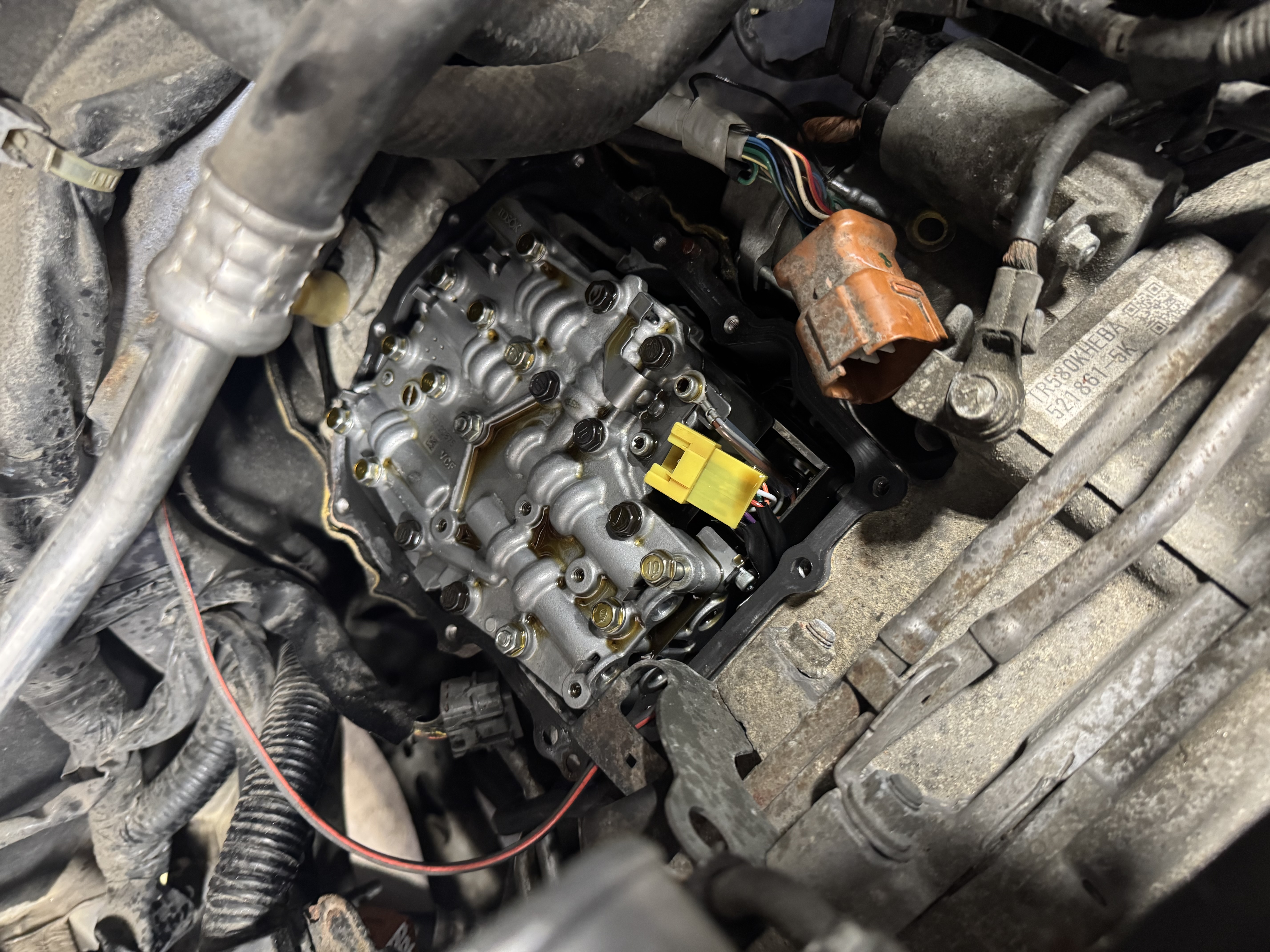
Subaru CVT AT Temp or check engine light? We diagnose and replace failed torque converter or AWD solenoids without a full valve body. Granby CT Subaru specialists.
If your Subaru’s AT temp light is on or flashing, and the check engine light has joined the party, you’re not alone. We see this regularly on late-model Subaru CVT vehicles around Granby and Hartford County. The dealer’s answer is often to replace the entire valve body and call it a day—an expensive day. At College Highway Auto, we take a smarter approach: confirm the failure, then replace only the bad solenoid inside the CVT valve body when testing proves it. That saves you time and money, and gets your Subaru safely back on the road.
Most commonly, the problem is a failing torque converter clutch (TCC) control solenoid or the AWD transfer (AWD duty) solenoid. Either can trigger limp mode, an AT temp light, or locking/binding behavior in turns. On the vehicle featured in our shop notes, the AWD solenoid measured far outside Subaru’s spec of roughly 3 ohms—clear confirmation that the solenoid coil itself was faulty.
Below, we explain symptoms, how we diagnose these issues the right way, and how our in-house solenoid replacement service lets you avoid a full valve body replacement. If you’re in Granby, Simsbury, East Granby, Suffield, Windsor Locks, Bloomfield, Avon, or nearby, we’re here to help.
Common symptoms of a failing torque converter clutch solenoid or AWD transfer solenoid on Subaru CVT models (TR580/TR690 and similar) include:
- AT temp light on solid or flashing, sometimes after highway driving or while climbing grades - Check engine light (MIL) and possible AWD or traction indicators - Limp mode with reduced power, limited RPM, or fixed gear ratio feel - Harsh engagement, delayed engagement, or a shudder on takeoff - Torque bind or binding in tight parking lot turns (especially after a few minutes of driving) - Front-wheel-drive-only feel, or intermittent loss of rear drive - Stalling at stops or near-stall when the torque converter clutch sticks on - Highway surge or flare, or increased RPM with poor acceleration - Elevated CVT temperatures due to improper clutch control
Typical Subaru CVT DTCs we encounter with these failures include:
- P0741 Torque Converter Clutch System Performance or Stuck Off - P2763/P2764/P2769 TCC Solenoid Electrical/Performance - Transfer clutch/AWD control related codes (varies by model/year) - Line pressure or solenoid performance codes
Note: A failing wheel speed sensor or poor battery/charging system can set transmission-related codes too, so we always confirm root cause with testing. We never recommend replacing parts without data to back it up.
Our diagnostic process focuses on evidence. The goal is to prove whether we’re dealing with a solenoid, wiring, fluid/temperature issues, or an internal mechanical fault. Here’s how we approach it:
1) Interview and road test - We ask when the AT temp or MIL first appeared, what driving conditions were present, and whether the symptom is hot, cold, or both. - Short and extended test drives replicate the concern. We pay attention to launch shudder, binding in turns, and torque converter clutch behavior.
2) Full-system scan - We scan the ECM, TCM, ABS, and AWD modules for DTCs and freeze-frame data. - We note codes like P0741, P2763/P2764, and AWD/transfer clutch control codes by subsystem, not just the engine module.
3) Live data evaluation - We monitor TCC slip RPM, commanded vs. actual torque converter clutch state, transfer clutch duty, line pressure command, CVT temperature (including ATF and CVT temp sensor values), and wheel speed inputs. - Abnormal TCC slip (for example, high slip when commanded on) or transfer clutch duty values that don’t match vehicle behavior point us in the right direction.
4) Electrical testing of the suspect solenoid - With the CVT safely accessible, we measure coil resistance against Subaru specifications. On the job referenced in our shop notes, the AWD solenoid coil resistance read way out of the factory spec of about 3 ohms, confirming an internal solenoid failure. - We inspect harnesses and connectors for corrosion, fluid wicking, pin tension, and damage. - When appropriate, we perform a current ramp test with an amp clamp to evaluate solenoid operation under command.
5) Fluid and thermal checks - We verify fluid condition, contamination, and odor. Burnt or debris-laden CVT fluid may contribute to control issues and will be addressed during repair. - We confirm that the CVT reaches proper temperature and that the temperature sensor is reporting accurately, since the Subaru CVT uses a temperature-based fill and control strategy.
6) Updated service info and TSBs - We review Subaru technical bulletins and software update notes to ensure we’re not chasing a known calibration issue.
This process lets us pinpoint whether the problem is a control solenoid like the TCC or AWD unit, a wiring/fuse issue, fluid/temperature concerns, or an internal mechanical fault in the transfer clutches or torque converter. Only after we confirm the fault do we recommend repair.
When testing confirms a failed torque converter clutch solenoid or AWD transfer solenoid, we offer an in-house repair that replaces only the bad component instead of the entire valve body assembly. Subaru dealers often replace the valve body as a unit; while that’s sometimes necessary, it’s not always required. Our approach can save a substantial amount without compromising reliability.
What we do step-by-step:
- Prepare and drain: We secure the Subaru on a lift, protect underbody panels, and drain the CVT fluid to a clean container to assess condition. We disconnect the battery when appropriate.
- Access the valve body: We remove the CVT pan and related components to expose the valve body and its internal solenoids. Cleanliness is key—no lint, no grit. We use proper torque procedures on every fastener.
- Identify and test: We identify the specific solenoid (TCC or AWD transfer). We confirm the coil resistance and, when applicable, perform bench tests to validate what we saw during on-car diagnosis.
- Replace the faulty solenoid: We install a high-quality replacement solenoid that matches the Subaru application. In our highlighted case, the AWD solenoid that measured far outside the 3-ohm spec was replaced. Seals and O-rings are renewed as needed.
- Reassemble and torque: The valve body is reinstalled with correct torque sequences. We replace the pan gasket or sealant as designed, and reattach all harnesses with careful routing and secure clips.
- Fill with the correct fluid: Subaru CVT units are sensitive to fluid type. We use the specified Subaru CVTF (Lineartronic/HP as applicable) and follow the temperature-based fill procedure using a scan tool to monitor fluid temp. The shifter is cycled through each range to purge air and stabilize level.
- Relearn and verification: We clear codes, perform any required clutch or line pressure learn routines, and road test through a full temperature cycle. We re-check for leaks and verify smooth operation, normal TCC lockup, proper AWD engagement, and no binding in turns.
- Transparent results: We show you the failed readings (for example, coil resistance significantly off the ~3-ohm spec) and the post-repair data so you know exactly what was fixed and why.
How long it takes: - Most confirmed solenoid replacements are completed the same day or next business day, depending on model, parts availability, and how quickly we can complete the fill/learn road tests.
Cost expectations: - Replacing a single failed solenoid generally runs significantly less than a full valve body replacement. Many jobs land in the mid hundreds to around the low thousands, while a valve body can be several thousand dollars installed. We’ll provide an estimate after diagnosis so you can make an informed decision.
What if issues remain? - If testing reveals transfer clutch wear, torque converter failure, or contamination severe enough to damage multiple control elements, we’ll discuss options, which can include additional repairs or, in serious cases, a valve body or transmission assembly. The key is that we start with diagnostics, so you only pay for what you actually need.
In Granby and across Hartford County, your Subaru’s AWD is a safety feature as much as a convenience—especially in rain, snow, and leaf-slicked backroads. A failing AWD or torque converter solenoid compromises traction, drivability, and can force your CVT into limp mode at the worst possible time. Left unaddressed, excessive slip or heat can accelerate internal wear and raise repair costs.
By diagnosing precisely and replacing only the failed solenoid when appropriate, we help you:
- Restore safe AWD performance and confidence in poor weather - Avoid an unnecessary full valve body replacement - Keep repair costs reasonable while maintaining reliability - Protect the CVT from heat-related damage caused by improper clutch control
We live and drive here too. Whether you commute from Simsbury, coach soccer in Suffield, or head to the trails near Granby, you deserve a Subaru that engages its torque converter and AWD systems correctly every time you drive.
Common signs include an AT temp light on or flashing, check engine light, limp mode, shudder on takeoff, binding in tight turns, intermittent loss of rear drive, or stalling at stops if the torque converter clutch sticks. You may also notice higher RPM with poor acceleration or surging at highway speeds.
Not always. If testing confirms that a specific solenoid (like the torque converter clutch or AWD transfer solenoid) has failed, we can replace just that solenoid and related seals. Dealers often replace the whole valve body, but targeted repair can be a reliable, cost-effective solution when the rest of the valve body is healthy.
We scan all modules, check live data for TCC slip and AWD duty behavior, and perform electrical tests including coil resistance, connector and pin integrity, and sometimes current ramp testing. We verify fluid condition and temperature sensor readings, and we road test before and after repairs. We only recommend replacing a solenoid when the data supports it.
The AWD transfer solenoid typically measures around 3 ohms. In our featured repair, the solenoid’s resistance was significantly outside that spec, confirming an internal failure. Exact specifications vary by model and year, so we reference Subaru service information for your VIN.
We see this on a wide range of Subaru CVT-equipped vehicles including Outback, Forester, Crosstrek, Impreza, and Legacy models with TR580/TR690 and related CVTs. Symptoms and codes can vary by year and trim, but the diagnostic approach is similar.
Yes. Faulty wheel speed sensor inputs or low system voltage can trigger transmission and AWD-related codes and limp mode. That’s why we always verify the electrical system and sensor data before calling a solenoid or mechanical component bad.
Most confirmed solenoid repairs are completed the same day or by the next business day, depending on model and parts availability. We use the specified Subaru CVTF and follow the temperature-based fill and relearn procedures. If the fluid is contaminated or degraded, we’ll discuss service options during the repair.
Replacing a single solenoid generally costs far less than a complete valve body assembly. Many repairs fall in the mid-hundreds to around the low-thousands depending on model, parts, and fluid. We provide a written estimate after diagnosis so you can make an informed decision.
If symptoms persist, we recheck for mechanical wear in the transfer clutches or torque converter, as well as any additional electrical or hydraulic issues. In some cases, further repairs or a valve body may be required, but we won’t recommend additional parts without confirming the cause.
Yes. We stand behind our diagnostics, parts, and workmanship with a warranty appropriate for the component and vehicle. We’ll review coverage details on your estimate so you know exactly what’s included.