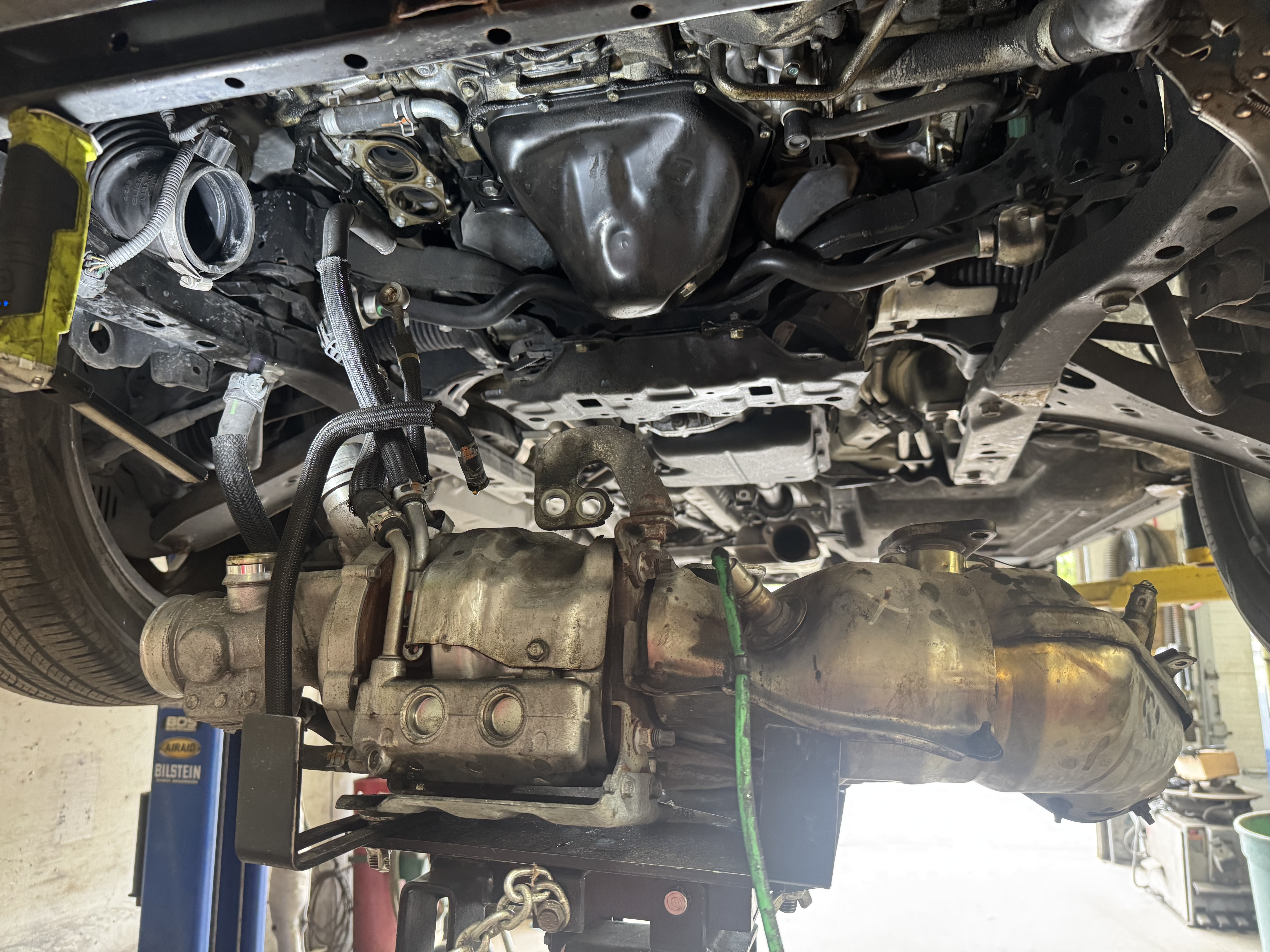
2020 Subaru Ascent FA24 repair in Granby, CT: turbo/manifold removal as one unit to replace intake cam sprocket and reseal the front timing cover. Clear, tested process.
This 2020 Subaru Ascent came to College Highway Auto in Granby, CT with two concerns that often travel together on Subaru’s FA24 2.4L turbo engines: an intermittent intake cam timing fault on the passenger side and an oil leak at the front timing cover. To get the job done right, the turbocharger and exhaust manifold assembly must come off as one piece. Doing it this way gives us proper access to the timing cover and the intake camshaft sprocket without fighting corroded studs or risking a mis-timed chain.
If you drive an Ascent—or an Outback XT, Legacy XT, or other Subaru with the FA24—you might wonder: why pull the turbo and manifold as a unit? What symptoms point to a cam sprocket issue? How do we confirm a timing cover leak and not some other oil source? Below, we’ll walk through the symptoms we look for, the tests we perform before recommending parts, and the professional process we use to remove the turbo/manifold assembly, reseal the timing cover, and replace the intake cam sprocket when needed. We’ll also talk about why keeping these engines clean with frequent full-synthetic oil changes matters so much in Hartford County’s real-world driving, from Simsbury to Southwick and right here in Granby.
What the driver notices and what we see under the car can point us in the right direction before a wrench ever turns.
Common driver complaints with FA24 intake cam phasing faults: - Check Engine Light with cam timing codes (often P0011, P0014, or correlation codes on Bank 1—the passenger/right side on a North American Subaru) - Rattle for a second or two on cold start that fades quickly - Noticeable lack of low-end torque or surging at light throttle - Rough idle when warm, then it clears up after a key cycle
Common signs of a front timing cover oil leak: - Wet, oily residue at the lower right-front of the engine, often tracking back along the subframe - Burnt oil smell after parking, especially in colder weather - Oil drip marks near the A/C compressor area or on splash shields - Gradual oil level loss between oil changes, with no visible smoke
Turbo/manifold removal clues we see in the bay: - Access is tight around the timing cover and right-side cam sprocket with the turbo system in place - Heat shielding and the integrated turbo/manifold assembly block tool access to the front cover bolts and chain service procedures - Manifold hardware often shows corrosion—removing the assembly as one unit is safer for studs and gaskets than splitting it on the car
If this describes your Ascent, don’t panic. These are solvable problems. The key is to confirm cause before replacing any part. That’s our job, and that’s what we do for Subaru owners in Granby, East Granby, Canton, and the wider Hartford County area every week.
We don’t recommend a cam sprocket or timing cover reseal until we’ve proven the cause. Here’s how we diagnose FA24 issues like this 2020 Subaru Ascent.
1) Scan data and freeze-frame review - We start by pulling codes and reading freeze-frame data to see engine speed, load, coolant temperature, and commanded vs. actual cam phasing at the moment the fault set. - We graph live camshaft advance on both banks during idle, light throttle, and snap acceleration. Healthy AVCS (active valve control) will respond quickly and return to target. A sticking intake cam sprocket or oiling issue will lag, overshoot, or drift.
2) Oil condition and pressure check - Dirty or thickened oil can slow AVCS response and trigger cam timing faults. We check oil level, viscosity history, and condition. Where appropriate, we verify base oil pressure hot to rule out supply issues to the VVT system and turbo. - We also evaluate service history. Extended intervals harden sealants and can contribute to cover leaks and sluggish cam phasing. We generally recommend full synthetic 5W-30 and 3,000-mile intervals on FA-series engines to keep varnish in check and AVCS happy.
3) Solenoid and screen verification - The intake oil control solenoid is commanded during tests to confirm response. We inspect for debris at the oil feed screen where applicable, and verify electrical integrity. If the solenoid or circuit is the culprit, we address that before any mechanical repair.
4) Correlation and mechanical checks - Using factory procedures, we confirm base timing correlation. On FA24, this includes aligning timing marks and ensuring the chain hasn’t jumped. If correlation is off or the sprocket bleeds down internally when commanded, it supports replacement of the intake camshaft sprocket.
5) Leak source identification - Many Subaru oil leaks masquerade as timing cover leaks. We clean and UV-dye the engine, drive, and re-inspect with mirrors and a borescope. We pay attention to: - Front timing cover perimeter and RTV cross-joints - Upper oil pan seam (we see this on Subarus regularly and it can track forward) - Valve cover and cam cap perimeters - Oil cooler and oil filter base - Only after a clean, dyed verification do we call a timing cover reseal.
6) Turbo/manifold removal planning - Before disassembly we evaluate fasteners, O2 sensor condition, and coolant/oil lines to the turbo. If hardware is heavily corroded, we soak with penetrant and plan heat cycles. Pulling the turbo and exhaust manifold as a single assembly reduces the chance of snapping fasteners on-car and gives us the clear access we need to service the front cover and the cam sprocket correctly.
With data captured and the root cause confirmed, we outline the game plan and parts list with the vehicle owner. No guesswork, no parts cannon—just the right repair for the proven issue.
On this 2020 Subaru Ascent, we performed two major tasks: replace the right-side intake camshaft sprocket and reseal the front timing cover. Both require significant access, which is why we remove the turbocharger and exhaust manifold together as one assembly.
Step-by-step overview of our process
1) Preparation and safety - Battery disconnected and vehicle safely lifted. - Underbody panels removed. We pre-soak exhaust hardware, O2 sensor threads, and clamp connections. - Coolant and a small amount of oil may be drained or captured depending on turbo line routing and to minimize mess.
2) Remove the turbo/manifold assembly as one unit - Sensors unplugged and labeled: A/F (upstream O2), rear O2 if disturbed, turbo wastegate connector, and any heat shield thermocouples depending on trim. - Oil feed and return lines capped after removal with new crush washers noted for reassembly. Coolant feed/return lines disconnected and capped to prevent contamination. - Downpipe separated at the turbo outlet. We preserve the cat and downstream hardware. - Manifold fasteners at the heads loosened in sequence. Because the turbo and manifold share brackets and shielding, removing them together avoids prying on hot-side joints. - The entire turbo/manifold assembly is then lowered as a unit. This keeps the studs happier and gives us direct access to the front timing cover area and right-side cam components.
3) Access the timing components - Heat shields and ancillary brackets around the front cover are removed. Belt and crank pulley are removed following factory procedures, with attention to preventing engine rotation that could alter chain position unintentionally. - The front timing cover sealing surface is cleaned externally to prevent debris from entering the engine when the cover is removed.
4) Front timing cover removal and reseal - The front cover’s many bolts are removed in the correct order. Subaru uses RTV/FIPG at the cover and at critical cross-joints where the cover meets the block and upper oil pan; we map bead locations for reassembly. - With the cover off, we inspect the chain, guides, tensioner, and oil passages. If wear or debris is present, we document and consult the owner. - Surfaces are meticulously cleaned without gouging aluminum. We use the OEM-type sealant and apply the bead pattern per Subaru service information, paying attention to corners and dowel areas. After reinstallation, we respect the proper cure window before full heat load.
5) Intake camshaft sprocket replacement (Bank 1/right) - Cam position is locked using the appropriate service tools to maintain timing. The chain is secured so it cannot skip a tooth. - The intake cam sprocket is removed and inspected. Any scoring or lash issues are documented. A new OEM sprocket is installed, torque applied precisely per spec, and the AVCS oil passages are confirmed clean. - We perform a careful re-check of timing marks and chain alignment.
6) Reinstall turbo/manifold assembly - New OEM manifold gaskets, turbo outlet gasket, and fresh crush washers for oil and coolant lines are installed. High-heat hardware is replaced as needed. - Before connecting the oil feed, we prime the turbo with clean oil to protect the bearings on first start. - Lines are reconnected, sensors plugged in, and shielding refit. The downpipe joint is refastened with a new gasket.
7) Fluids, start-up, and verification - Coolant is refilled and bled using a vacuum-fill method to avoid air pockets. Engine oil is topped off with full synthetic 5W-30. - On first start, we monitor oil pressure, listen for exhaust leaks, and check for any coolant or oil seepage. We allow the engine to reach operating temperature, then perform an AVCS functional test and a road test. - After the drive, we reinspect the timing cover and all turbo connections for any signs of fresh leakage. We also re-verify cam advance tracking to ensure the new sprocket responds crisply and matches command values.
Why remove the turbo and manifold together? - Access and control: The integrated removal gives us a clean window to the timing cover and cam components without wrestling around the hot side. - Fewer broken fasteners: Splitting the turbo from the manifold on a 4-6 year old New England Subaru can snap studs. Taking it down as a unit reduces risk, keeps sealing faces intact, and speeds reassembly. - Better sealing outcomes: With room to properly clean and apply RTV, the reseal lasts. Rushed, in-car scraping around a still-installed manifold leads to repeat leaks.
Parts and quality We use high-quality OEM or equivalent gaskets and sealants designed for Subaru turbo heat. For this job, that typically includes intake cam sprocket (Bank 1), timing cover sealant, manifold-to-head gaskets, turbo outlet gasket, downpipe gasket, new copper/nickel crush washers, and replacement exhaust hardware as needed.
A seeping timing cover isn’t just a driveway spot. On FA24 engines, oil leaks can soften rubber, foul splash shields, and lower oil level over time. Low oil doesn’t just hurt bearings—it slows AVCS response, which triggers cam timing faults and robs torque. Combine that with a turbocharger that depends on clean, ample oil, and you have a recipe for accelerated wear if ignored.
Fixing the root cause—resealing the cover the right way, renewing the intake cam sprocket when confirmed faulty, and making sure the turbo oil and coolant connections are tight—restores the engine’s responsiveness and protects the catalytic converter from misfire damage. It also gives us a chance to baseline the vehicle: clean oil, verified timing, no leaks.
Maintenance matters more than marketing. We’ve seen extended oil changes harden sealants and gum up control passages. Our recommendation for Subarus we service in Granby, Hartland, Suffield, and across Hartford County is simple and effective: full synthetic 5W-30 and 3,000-mile oil change intervals. It keeps varnish out of AVCS, protects the turbo, and helps sealants last.
Bottom line: This is a repair you do once, correctly, with testing before and verification after. Your Subaru drives better, cleaner, and longer when the work is thorough.
Access and reliability. Pulling the turbo/manifold as one assembly gives clear access to the front timing cover and intake cam sprocket, reduces the chance of snapping corroded studs, and allows proper cleaning and resealing. It’s faster overall and produces a longer-lasting repair.
Common signs include intermittent Check Engine Light with cam timing codes (such as P0011/P0014), brief rattles on cold start, sluggish low-end torque, and cam advance that lags or drifts on scan data. We confirm with live data, commanded AVCS tests, and correlation checks before recommending replacement.
We degrease the engine, add UV dye, drive, and reinspect with mirrors and a borescope. The dye trail reveals the true source. We commonly see upper oil pan and valve cover seepage on Subarus; we won’t reseal the front cover unless dye testing proves it’s the culprit.
Not unless testing shows a turbo issue. We remove and reinstall the turbo/manifold assembly with new gaskets and crush washers, and we prime the turbo with oil before first start. If we find shaft play, oiling problems, or damaged wheels, we’ll document it and discuss options.
Most Subaru Ascent FA24 cam sprocket replacement and front cover reseal jobs take 1.5 to 2 days of shop time, allowing for proper cleaning, sealant cure, and thorough testing. Corroded hardware or additional leaks can extend the timeline.
Costs vary with parts condition and corrosion but generally include the intake cam sprocket, multiple gaskets and crush washers, OEM sealant, oil and coolant, and significant labor. After inspection, we provide a written estimate based on your vehicle’s needs—no guesswork.
It’s risky. Oil leaks tend to worsen, and running with low oil can harm the turbo and AVCS. Cam timing faults can lead to poor drivability and catalytic converter damage from misfires. We suggest diagnosing promptly and planning the repair to avoid secondary damage.
We recommend full synthetic 5W-30 and 3,000-mile intervals. Shorter intervals keep AVCS passages clean, help the turbo, and extend the life of sealants. Extended intervals often contribute to varnish, sluggish cam response, and leaks.
Yes. We use OEM or high-quality equivalent cam sprockets, gaskets, and crush washers, and we follow Subaru’s bead pattern with the correct RTV/FIPG for the timing cover. Exhaust hardware is renewed as needed, especially in New England vehicles.
We prime the turbo, refill and bleed coolant, and perform a controlled first start while monitoring for leaks. Then we test drive, graph cam advance vs. command, and inspect again with UV dye and mirrors. Only when it’s dry and data looks right do we call the job finished.