GM V8 misfire in 4‑cyl mode fixed in Granby CT. We diagnose lifter failure and perform a full DOD/AFM delete using genuine GM parts. Reliable, local repair.
A local GM truck rolled into College Highway Auto in Granby, CT with a frustrating complaint: it would run fine one minute, then stumble and misfire at light throttle the next—especially when the dash showed it had switched into 4-cylinder mode. The Check Engine Light would pop on and off, and the owner noticed a faint tick that got worse when it warmed up.
Our testing confirmed the story the truck was telling. The misfires correlated tightly with Displacement on Demand (DOD), also known as Active Fuel Management (AFM), cutting cylinders. One or more AFM lifters were hanging up and not fully returning, and a cam lobe was showing the early signs of distress. The fix needed to be both reliable and cost-effective for someone who tows and plans to keep the truck for years.
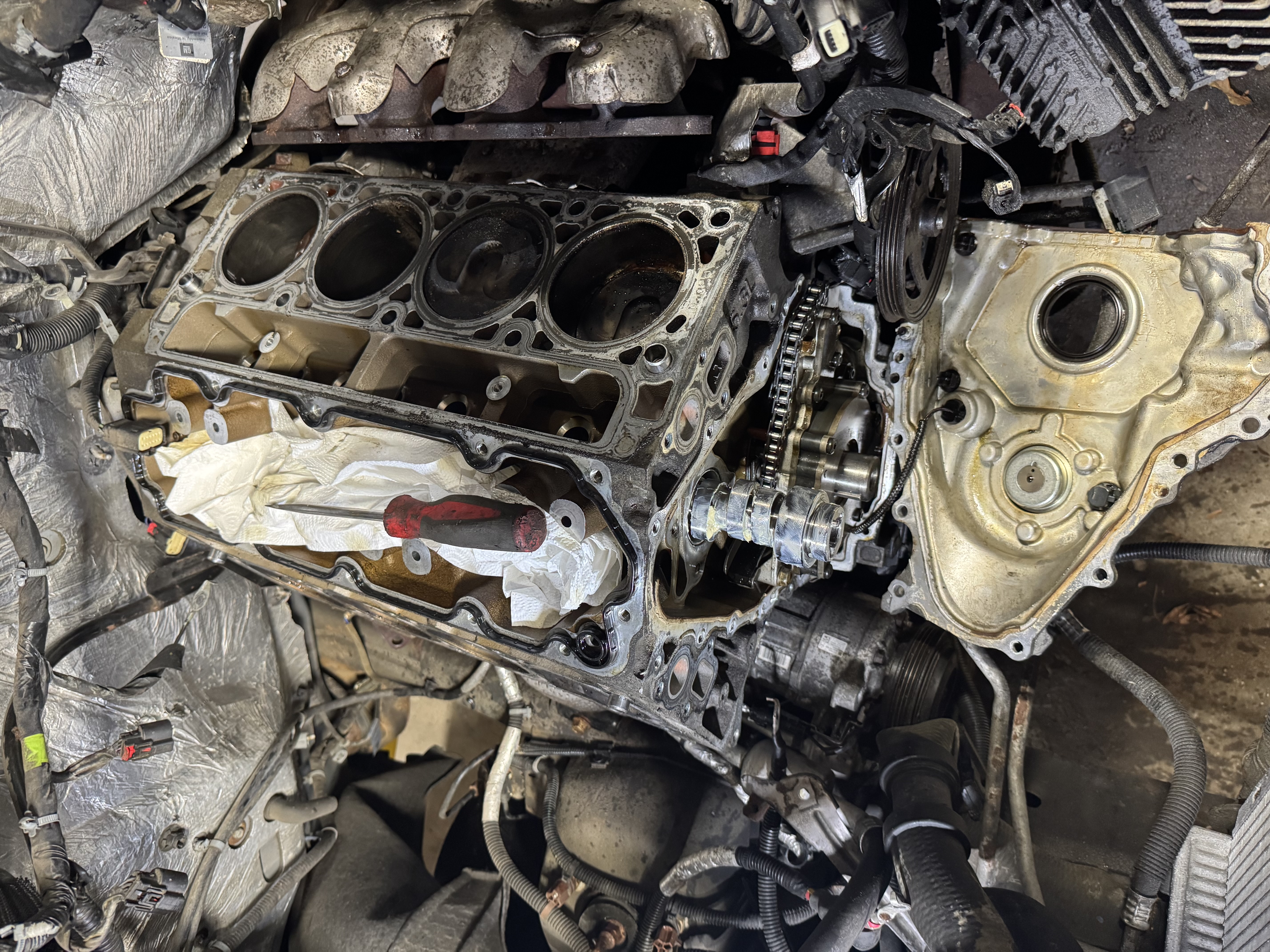
After walking the owner through options—including repairing the AFM system or removing the failure points entirely—we performed a full DOD/AFM system delete using genuine GM non-DOD camshaft and lifters, plus new GM gaskets and seals throughout. The result is a smooth, consistent V8 that no longer hunts between 4-cylinder and 8-cylinder modes and no longer misfires.
If your Silverado, Sierra, Tahoe, Yukon, Suburban, or Escalade is acting up when it enters 4-cylinder mode, our Granby team can test it properly and lay out your choices. We serve Hartford County and nearby communities like Simsbury, East Granby, Suffield, Windsor Locks, and Southwick, MA.
Common symptoms of GM DOD/AFM lifter and cam issues we see in Hartford County:
- Intermittent misfire at light throttle or steady cruise, especially when the display shows 4-cylinder mode - Check Engine Light with P0300 (random misfire) or misfire codes for specific cylinders (often the AFM cylinders) - Ticking or tapping noise from one bank, sometimes quiet on cold start and louder hot - Rough idle after a long highway run or after a deceleration into a stop - Noticeable shudder on hills when the engine tries to switch in and out of 4-cylinder operation - Occasional low oil pressure message or fluctuating oil pressure gauge (often paired with a clogged VLOM filter but can also accompany lifter/cam wear) - Reduced power, poor fuel economy compared to normal, and a general lack of smoothness
Those symptoms can overlap with coil, plug, injector, or even intake vacuum problems. That’s why we never recommend jumping to parts—AFM/DOD issues need a structured diagnosis first.
How we confirm a DOD/AFM lifter or cam problem before recommending any repair:
1) Interview and road test - We listen to the customer and drive the vehicle under the exact conditions that trigger the complaint—often a flat road at 35–55 mph where the ECM commands DOD. We note when the misfire counter ramps up and when the noise changes.
2) Scan tool data and bidirectional controls - Using a factory-level scan tool, we monitor misfire counts per cylinder, fuel trims, cam/crank correlation, and DOD command status. We’ll command DOD on/off (when supported) to see if misfires follow the mode change. If a misfire appears only during 4-cylinder mode, AFM lifters jump to the top of the suspect list.
3) Relative compression and cylinder balance - A relative compression test (current ramping) quickly flags a weak hole. We then do a mechanical compression and, when appropriate, a leakdown test to separate top-end valvetrain faults from ring/valve sealing issues. A collapsing AFM lifter often shows lower or inconsistent compression, especially hot.
4) Valvetrain observation - We can listen with a stethoscope and, when warranted, remove a valve cover to observe rocker travel and pushrod spin. A non-pumping or collapsed AFM lifter will limit valve lift. In borderline cases we’ll borescope for witness marks showing lobe distress.
5) Oil pressure and VLOM checks - We verify oil pressure with a mechanical gauge and inspect the tiny filter screen beneath the oil pressure sensor (a known clog point that affects the Valve Lifter Oil Manifold/VLOM). If that screen or the VLOM is compromised, it can starve AFM lifters of the precise control oiling they need.
6) Eliminate other causes - We confirm coils, plugs, injectors, MAF readings, and vacuum integrity are healthy. Misfires can be multi-factor; we don’t declare a lifter failure until we’ve ruled out the simple stuff.
7) Service information and bulletins - We check OEM procedures and bulletins for your exact engine code (5.3L, 6.0L, 6.2L, etc.). Some engine families have pattern failures; others have calibration updates that change DOD engagement thresholds.
Only after completing these steps do we sit down with you and present findings, options, and costs. In this case, the evidence—the misfires following DOD engagement, the hot compression variance, and valvetrain behavior—pointed squarely at AFM lifter sticking and early cam wear. The owner chose a long-term solution: a full DOD/AFM delete using genuine GM non-DOD components.
What a full DOD/AFM delete with genuine GM parts includes at our Granby shop:
The goal is simple: remove the components that can fail when switching in and out of 4-cylinder mode and install matched OE parts that keep the engine running as a full-time V8. On this job we performed the following with all genuine GM parts, gaskets, and seals:
- Non-DOD camshaft: Installed a genuine GM cam designed for non-AFM operation to match the valvetrain profile. - Standard non-AFM lifters: Replaced all eight AFM lifters with a full set of standard lifters for every cylinder, along with new lifter trays to ensure proper retention and oil control. - Cylinders heads off, cleaned, and resealed: Removed both cylinder heads for access and inspection. Cleaned oil passages, checked guides and seats, and reinstalled with new GM head gaskets and torque-to-yield head bolts. - Valley cover update: Replaced the AFM valley cover (with its oil solenoids) with the correct non-AFM cover and new gasket, eliminating the internal oil circuits that feed AFM lifters. - Timing components and seals: Inspected the timing chain, guides, and tensioner; replaced as needed. Installed new front crank seal, timing cover gasket, rear main seal (if required), and a fresh oil pump pickup O-ring. - Rockers, pushrods, and trays: Verified rocker and pushrod condition and replaced any marginal parts. Installed new lifter trays per GM procedure. - Intake/exhaust and coolant interfaces: New GM intake manifold gaskets, throttle body seal, exhaust manifold gaskets, and coolant crossover seals as required. - PCM calibration: Updated the engine control module to disable AFM in software so the truck never attempts to enter 4-cylinder mode. All emissions monitors remain intact; only cylinder deactivation is disabled.
Attention to detail matters. During reassembly we: - Prime the oiling system and confirm pressure before first start. - Verify cam/crank correlation and reset learned values as needed. - Perform a controlled break-in on the fresh components. Although these are roller lifters and not flat-tappet, we still follow best practices: bring the engine up to temperature, vary RPM, and avoid extended idling in the first few heat cycles. - Road test through multiple conditions, including the speeds that previously triggered 4-cylinder operation, to confirm a smooth, consistent V8 with stable misfire counters (zero) and clean fuel trims.
Results on this vehicle: - The intermittent misfire is gone. - No more mode-based stumble—the truck stays in full V8 at all times. - Tick is eliminated, and hot restart feels crisp.
Owner care and maintenance after a DOD/AFM delete: - Oil choice and interval: We recommend full synthetic 5W-30, dexos-approved, and a strict 3,000-mile interval. We’ve seen extended intervals harden seals and contribute to varnish that can accelerate lifter and cam wear—even on engines without AFM. - Early oil change: We schedule a free inspection and oil change at about 500 miles after the repair to flush any assembly debris and recheck for seepage. - Use case: Many owners who tow, plow, or do a lot of stop-and-go prefer this setup for its consistency and reliability versus mode switching. Expect fuel economy to dip slightly (often 0.5–2 mpg), offset by smoother drivability and fewer AFM-related surprises.
Alternatives we discuss before any delete: - If the AFM lifter/cam are healthy and the issue is limited to oil control (like a clogged VLOM screen) or a single marginal component, a targeted repair can sometimes keep AFM active. We lay out pros and cons and let you decide.
A note on regulations and customer choices: - Cylinder deactivation is primarily a fuel-economy strategy; disabling it may be considered a modification. We perform this repair when mechanical failure makes it the prudent, owner-requested path. We retain all emissions equipment and confirm OBD readiness. If you have questions about on-road use regulations, we’ll discuss them up front so you can make an informed decision.
Why removing DOD/AFM can be the right long-term move:
- Eliminates a high-failure subsystem: AFM lifters are complex. When they stick or collapse, they can wipe cam lobes and cause repeat failures. A non-AFM cam and standard lifters remove that weak link. - Consistent oiling: Without the VLOM pulsing special lifters, oil pressure distribution is more stable—good for engines that tow, idle long periods, or see wide temperature swings around Granby and Hartford County. - Predictable performance: Many drivers prefer the feel of a steady V8 with no 4-cylinder transitions or shudder under light load. - Serviceability: Standard lifters and a non-AFM cam are simpler to diagnose down the road and less sensitive to minor oiling variances.
Trade-offs are honest and small: - You may see a slight decrease in fuel economy under light cruise. For most owners who selected this option, the reliability benefit outweighs the mpg change.
Bottom line: If your GM V8 is misfiring when it drops into 4-cylinder mode and you plan to keep the vehicle, a properly executed DOD/AFM delete with genuine GM parts is a proven path to a smooth, durable engine.
Displacement On Demand (also called Active Fuel Management) is GM’s system that temporarily deactivates half the cylinders under light load to save fuel. It uses special lifters and a valve lifter oil manifold (VLOM) to switch valve operation on and off. Over time, varnish, oiling issues, and wear can cause AFM lifters to stick or collapse and even damage the camshaft lobes, leading to intermittent misfires, ticking, and roughness—often when 4-cylinder mode engages.
We correlate misfire counts with DOD engagement using a factory-level scan tool, perform relative and mechanical compression tests, inspect valvetrain motion, verify oil pressure, and check the VLOM filter. If misfires appear only in 4-cylinder mode and a cylinder shows reduced lift or compression, an AFM lifter is likely at fault. We still verify ignition and fuel first—no guesswork.
Not always. If testing shows the lifters and cam are healthy and the problem stems from oil control or a single marginal component, a targeted repair may retain AFM. We’ll lay out both routes—repairing AFM or removing it—and help you decide based on budget, use (towing, plowing, commuting), and how long you plan to keep the vehicle.
Typically: a genuine GM non-AFM camshaft, a complete set of standard lifters, new lifter trays, a non-AFM valley cover, head gaskets and new head bolts, timing cover and associated seals, intake/exhaust gaskets, and any worn timing components. We also update the PCM calibration to disable AFM commands so the engine runs as a full-time V8.
Cylinder deactivation is a fuel-economy function. Disabling it may be considered a modification depending on local and federal rules. We perform this repair when mechanical failure makes it advisable and at the owner’s request. Emissions equipment remains in place and OBD readiness is verified. We’re happy to discuss compliance so you can make an informed decision.
Most owners report a small decrease—typically about 0.5 to 2 mpg—because the engine no longer runs in 4-cylinder mode at light load. In return, you gain smoother, more predictable performance and eliminate a common failure point.
Time and cost depend on engine family, condition, and any collateral damage (for example, a worn cam lobe or timing components). Many jobs take several days including machine-time checks, resealing, calibration, and multiple road tests. After diagnosis, we provide an itemized estimate before work begins.
We recommend full synthetic 5W-30, dexos-approved, and a firm 3,000-mile oil change interval. We’ve seen extended intervals contribute to varnish and seal hardening, which can shorten valvetrain life. We also schedule a 500-mile post-repair inspection and oil change to flush assembly residue and recheck for leaks.
Most owners say it drives better—no mode transitions or shudder under light throttle and a more linear feel when towing. Power output is unchanged at wide-open throttle; you may notice a slightly steadier idle and improved throttle response.
We commonly see 5.3L, 6.0L, and 6.2L GM V8s in Silverado, Sierra, Tahoe, Suburban, Yukon, and Escalade models. That said, we test every vehicle individually because symptoms can overlap with ignition, fuel, or intake problems.