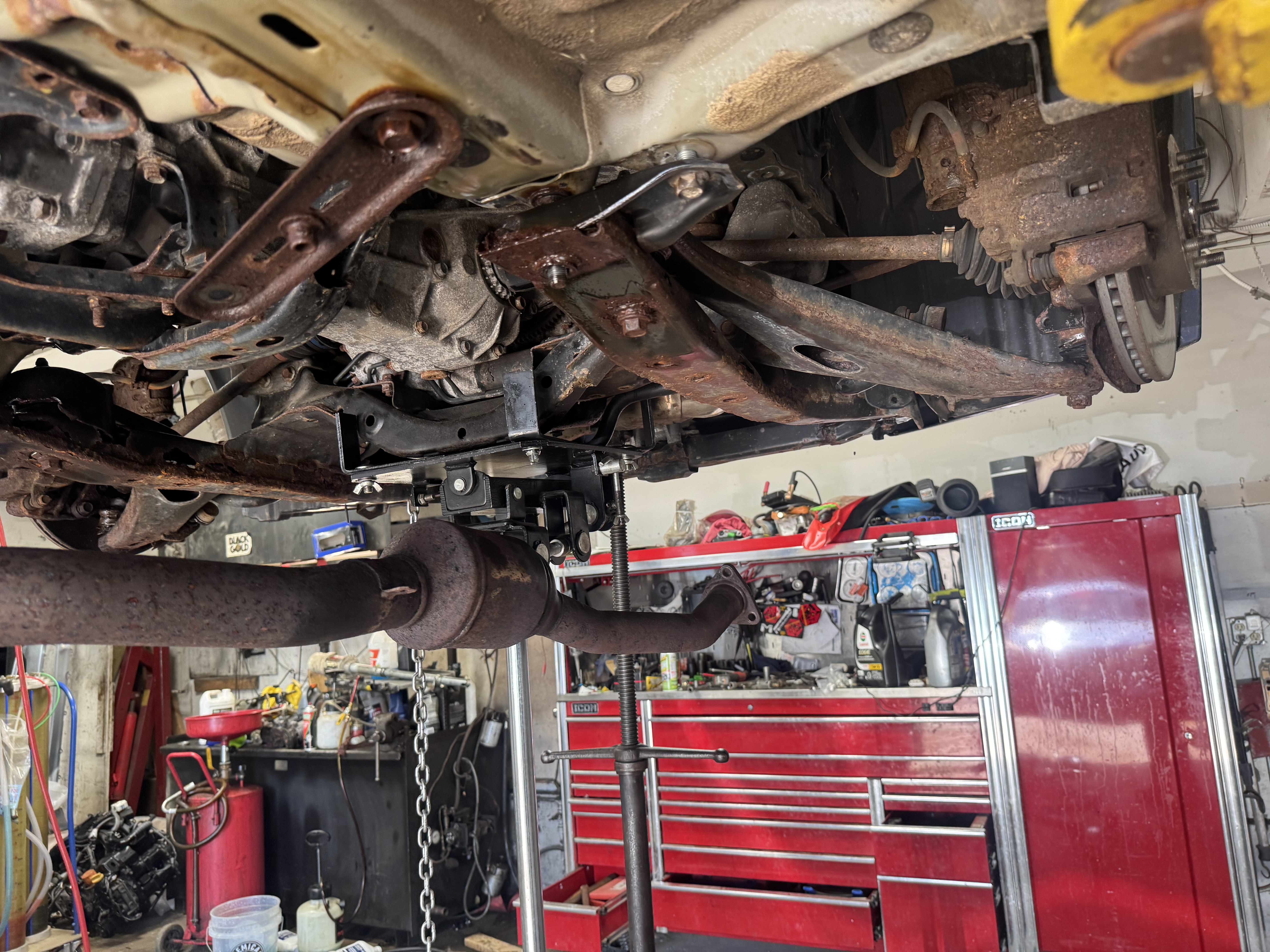
Comprehensive Subaru front frame replacement for severe rust damage. Learn how College Highway Auto in Granby CT diagnoses and repairs frame rot safely and precisely.
At College Highway Auto located in Granby, CT, we recently encountered a 2010 Subaru Legacy with an alarming front frame issue. This particular vehicle’s front frame showed severe rust deterioration, especially on the driver’s side, so much so that the left front wheel exhibited about 3 inches of lateral play. This is an extraordinary amount of movement, indicating a compromised structural component that not only affects drivability but more importantly, the safety of the vehicle. Front frame integrity on Subaru models, particularly those from earlier generations, is critical to maintaining proper suspension alignment, steering precision, and collision protection.
This level of frame deterioration is typically caused by prolonged exposure to road salt and moisture common in our Hartford County winters, combined with Subaru models’ structural design which can sometimes trap corrosion-prone areas. Our team naturally prioritizes thorough diagnosis, safely verifying the extent of rust damage before recommending the best course of action. Frame replacement is a major repair that requires specialized equipment, precise welding, and expert knowledge of Subaru chassis and suspension geometries.
For Subaru owners in Granby CT, Simsbury, East Granby, Suffield, Windsor Locks, and the surrounding areas, timely detection and repair of frame deterioration is essential to avoiding costly secondary damage. In this article, we share the in-depth diagnostic steps, detailed repair process, and reasons why addressing frame rot immediately is so important. At College Highway Auto, we believe in educating our customers with transparent, professional insights to help keep your Subaru safe, reliable, and structurally sound.
The most obvious symptom indicating a severely rusted front frame on this 2010 Subaru Legacy was excessive play from the left front wheel when checked by hand. When a wheel has 3 inches of left-to-right movement, it’s far beyond normal wheel bearing or suspension wear and points directly to a structural failure of the mounting points or frame rails. Drivers typically do not experience this symptom until the vehicle has accumulated extensive corrosion damage undermining the metal’s integrity.
Common signs that a front frame may be compromised include detectable looseness or wobble in the steering, unusual clunking or knocking noises during cornering or over bumps, uneven tire wear, and misalignment issues that cannot be corrected by standard wheel alignment procedures. In extreme cases like this Legacy, visual inspection shows visible rust flakes, bubbling paint, and holes in critical frame areas near suspension mounting points. If driven in this condition, the vehicle becomes unpredictable, increasing the risk of suspension detachment or even catastrophic collapse of the front end frame.
Additionally, owners often notice shifting or binding during steering, making the Subaru challenging and unsafe to handle on the road. This symptom generally warrants immediate inspection as it translates to lost precision and control, conditions no driver should accept. Road vibrations or banging under the vehicle while driving can also signal frame problems, especially if these noises increase during acceleration, braking, or turning.
When frame rot progresses this far, it’s a severe safety concern because the affected structural member supports key suspension components like control arms, the steering knuckle, and shock mounts. The compromised frame loses its ability to properly locate and support these parts, thereby causing abnormal stress on the steering linkage and suspension bushings. This often creates a chain reaction of accelerated wear throughout the chassis.
In a practical sense at College Highway Auto, during a routine suspension check for Subaru Legacy models showing any steering or suspension symptoms, our technicians inspect the entire front frame thoroughly for rust, erosion, or metal fatigue—particularly in older models or those from areas with heavy winter salt use. Detecting abnormal wheel movement early can prevent total frame failure, provide vehicle safety assurance, and maintain proper alignment geometry before expensive repairs are unavoidable.
Diagnosing severe frame rust on a Subaru Legacy requires a systematic approach combining visual inspection, mechanical testing, and detailed measurements to determine the extent of damage precisely. Below are the key diagnostic steps we follow at College Highway Auto in Granby, CT:
1. **Initial Visual and Physical Inspection**: Our certified technicians begin by raising the vehicle safely on a lift to expose all areas of the front frame near the wheel wells and suspension mounts. We look for rust discoloration, flaking, and any signs of metal thinning or perforation. Pay special attention to left front frame rails where exposure to road salt concentrates corrosion. We also manually stress the wheel assembly to detect abnormal play.
2. **Wheel Play Measurement**: Testing the lateral play at the front wheel provides objective data. For this Subaru, measuring 3 inches side to side in the left front wheel was a clear red flag. Normal wheel play is under a quarter-inch, typically accounted for by suspension bushing flex or wheel bearing slack.
3. **Suspension and Steering Component Assessment**: To isolate the problem, we test suspension joints, ball joints, tie rod ends, and strut mounts for wear. If all these components are within normal limits but excessive play persists, the frame is likely the failure point.
4. **Frame Rail Thickness Gauge Reading**: We use ultrasonic thickness gauges when required to measure remaining metal thickness on frame rails, comparing to factory specifications.
5. **Alignment Test and Geometry Check**: With specialized alignment tools, we assess whether the frame still holds the suspension geometry within manufacturer standards. Deviations indicate frame distortion or rust weakening.
6. **Frame Alignment Jig Assessment**: For highly suspected rot cases, we use frame alignment jigs to evaluate deformation by comparing critical measurement points to factory Subaru Legacy specs. Any variance greater than tolerance confirms frame integrity loss.
7. **Rust Severity and Extent Documentation**: Documenting the rust extent photographically and with notes to support repair planning and insurance claims where applicable.
8. **Safety Evaluation and Repair Feasibility**: Consult with Subaru manufacturer repair guidelines and safety standards to determine whether frame replacement is justified or if vehicle is beyond repair.
By following this diagnostic protocol, we ensure the root cause of the wheel play and instability is correctly identified as front frame rust and not an overlooked suspension or wheel bearing issue. Every step prioritizes safety and cost-effective repair solutions for Subaru owners in Granby CT, Hartford County, and nearby towns like Simsbury and East Granby.
Replacing the severely rusted front frame on a 2010 Subaru Legacy is a complex and labor-intensive repair requiring experience, specialized equipment, and adherence to automaker specifications. At College Highway Auto, our approach prioritizes restoring structural integrity, suspension geometry, and vehicle safety through a meticulous process:
1. **Vehicle Preparation and Safety Setup**: The Subaru is securely mounted on a frame rack and lifted to a comfortable working height. We disconnect the battery and remove all components attached to the front frame assembly, including suspension arms, steering linkage, drivetrain parts obstructing access, and electrical harnesses.
2. **Rusted Frame Removal**: Using cutting torches and reciprocating saws, we carefully separate the compromised frame sections, avoiding damage to adjacent body panels and mechanical parts. The severely rusted left front frame rail and its suspension mounting points are excised.
3. **Surface Preparation**: Once the rusted frame section is removed, surrounding metal is sanded and cleaned to expose sound metal edges. Any rusty adjacent areas are treated with rust converter and coated with anti-corrosion primer to prevent spread.
4. **Frame Replacement Panel Fitment**: OEM replacement frame rails and reinforcements specifically designed for the Subaru Legacy are test-fitted. This ensures exact replication of original dimensions and proper alignment for suspension mounting points.
5. **Welding and Joining**: Using high-quality MIG welding techniques, replacement frame rails are welded into place. At College Highway Auto, all welds are inspected visually and using magnetic particle inspection to guarantee penetration and structural soundness.
6. **Suspension Reassembly and Torque Specification**: With the new frame rails fully installed, suspension components including control arms, struts, steering linkage, and wheel hub assemblies are reattached. We reference Subaru factory torque specs to ensure fasteners are correctly tightened.
7. **Alignment and Geometry Verification**: Post-installation, we perform a full four-wheel alignment. This step is critical to restore proper handling and tire wear characteristics. We confirm suspension and frame measurements match Subaru’s factory tolerances.
8. **Corrosion Protection Application**: The new frame rail areas are coated with sound deadening and protective coatings tailored for salt and moisture resistance given Connecticut’s harsh winters.
9. **Road Test and Final Inspection**: After the repair, the vehicle undergoes a comprehensive road test to monitor steering response, suspension performance, and noise levels. Technicians listen for any abnormal feedback and confirm the absence of excessive wheel play.
10. **Customer Education and Documentation**: We explain repair details to the vehicle owner, emphasizing ongoing rust prevention steps and the importance of routine inspections given their geographic exposure.
Throughout the entire replacement procedure, College Highway Auto maintains clear communication with customers, providing realistic time frames and cost estimates upfront. Our team’s expertise assures Subaru owners in Hartford County, Granby CT, Simsbury, Suffield, and surrounding areas that their vehicle’s frame is returned to factory-level strength and safety compliance.
Addressing severe front frame rust on a Subaru Legacy is not just a matter of cosmetic restoration or suspension tuning — it's vital for the safety of the driver, passengers, and other road users. The front frame is a major structural element designed to absorb and distribute crash forces, support suspension geometry, and maintain alignment of wheel assemblies. When rust compromises this component, the vehicle’s entire handling and crashworthiness can be compromised.
In Granby CT and greater Hartford County, winter road salt and moisture accelerate corrosion risks, impacting metal components including the front frame. Left untreated, rust can progress to the point where suspension mounting bolts lose their grip or frame rails crack and collapse. This leads to unstable steering, unpredictable vehicle behavior, and potentially catastrophic mechanical failures while driving.
For Subaru owners, the Legacy model’s specific chassis design makes careful attention to frame condition essential. Failure to replace or repair corrosion damage can result in further frame distortion, increased tire wear, misalignment that can’t be corrected through standard adjustments, and unsafe handling.
From a liability standpoint, driving a vehicle with a structurally compromised front frame poses legal and insurance issues, especially after an accident. Additionally, resale and trade-in value diminish drastically if significant frame damage is present.
At College Highway Auto, we emphasize that timely identification and expert repair of frame rot keeps Subarus safe, reliable, and roadworthy. Our detailed diagnostic process ensures no hidden damage goes undetected, and our precision frame replacements restore factory strength and function.
Furthermore, following repair, ongoing rust prevention and routine inspections are discussed with customers to avoid repeat issues. Subaru owners living near Simsbury, East Granby, Suffield, Windsor Locks, and other Hartford County towns benefit from our local knowledge of environmental corrosion challenges unique to this region.
In conclusion, addressing front frame rot promptly is essential not only to preserve vehicle safety and performance but also to protect your investment and peace of mind in daily driving.
Severe front frame rust on Subaru vehicles in Connecticut is primarily caused by prolonged exposure to road salt, moisture, and winter conditions common in the Hartford County region. Salt accelerates corrosion on steel components, especially in structural areas near the wheels where debris and salt accumulate.
Common indicators include excessive play or wobble in the front wheels, unusual noises while turning or going over bumps, visible rust flaking or holes near suspension mounting points, uneven tire wear, and steering instability. If you detect more than a small amount of lateral wheel movement during inspection, it’s a sign of possible frame damage.
No, not all rust requires frame replacement. Surface rust or minor corrosion can often be treated and sealed. Frame replacement is only recommended when rust compromises the structural integrity or creates unsafe levels of movement, such as in cases where suspension mounts or frame rails are heavily eroded or perforated.
Wheel alignment alone cannot fix problems caused by frame rust because the rusted frame can distort suspension mounting points and geometry. While alignment restores wheel angles, the underlying unstable frame will continue to cause handling problems and unsafe conditions if not repaired.
Depending on the severity of rust and additional suspension work needed, frame replacement typically takes several days. This includes vehicle disassembly, cutting out rusted portions, welding new frame rails, reassembly, and alignment. Our shop provides a precise estimate based on each Subaru’s condition.
Yes. When performed properly by experienced technicians using OEM replacement parts and precise welding, frame replacement restores structural integrity, ensuring safe steering, proper suspension operation, and effective crash protection equivalent to factory standards.
Yes. Regular washing and undercarriage cleaning during winter months to remove salt, rust inhibitors, rust-proof coatings, and timely repairs of minor rust can significantly reduce corrosion risk. Routine professional inspections are recommended, especially in salt-exposed areas.
Usually, insurance does not cover rust-related damages as they are considered maintenance issues. However, if frame damage results from a collision, repair costs may be covered. It’s important to check your policy and discuss specifics with your insurer.
Rust damage, particularly to structural components like the frame, drastically lowers resale and trade-in value. Potential buyers or dealerships often view rusted frames as safety hazards requiring costly repairs, making the vehicle less desirable.
Driving a vehicle with a rusted front frame causing significant play is unsafe and not recommended. It risks sudden steering or suspension failures. It is best to have an immediate mechanical inspection and avoid driving until repaired.