Experiencing a P2757 code on your 2021 Subaru Crosstrek? Learn how College Highway Auto in Granby CT diagnoses and repairs torque converter clutch failure—beyond solenoids, including torque converter and seal replacement to restore smooth shifting.
At College Highway Auto in Granby, Connecticut, we often see 2021 Subaru Crosstreks come into the shop with a P2757 code indicating a torque converter clutch (TCC) failure. While a common first suspicion is a faulty solenoid, our thorough diagnostics go well beyond that to accurately pinpoint the root cause. In fact, this case was unique—it wasn’t a solenoid failure at all, but rather the torque converter slipping along with input shaft seal issues. Our expert team employs data logging and ohm testing to confirm symptoms and identify the correct repairs. This detailed approach helps restore your vehicle's performance and protects your transmission from further damage. Whether you’re in Hartford County, Simsbury, or nearby towns like East Granby and Suffield, understanding the intricacies of this repair can help you make informed decisions about your Subaru’s care. Maintaining robust torque converter clutch operation is crucial not only for smooth driving but for the long-term health of your transmission. Let us guide you through what this fault means, our diagnostic process, and how a proper repair can get your Crosstrek back on the road with confidence.
When the P2757 trouble code appears on a 2021 Subaru Crosstrek, it generally indicates a problem with the torque converter clutch's ability to engage properly. Customers often report several driving symptoms that accompany this code, including hard or delayed shifting, excessive transmission slippage, and fluctuating engine RPMs at cruising speeds. In some cases, the torque converter may fail to lock up, which manifests as reduced fuel efficiency and a noticeable lack of power delivery during acceleration. Drivers might also experience a rough or jerky feel when the transmission is trying to engage the torque converter clutch. These symptoms can have multiple causes, so a comprehensive analysis is key before deciding on replacement parts. In our Granby CT shop, customers from surrounding Hartford County and nearby towns like Windsor Locks regularly bring their vehicles in with similar complaints. They often express concern when standard scanning tools only reveal the P2757 code, leaving them uncertain whether the issue is a solenoid, wiring, or mechanical failure inside the transmission. We educate each customer that while solenoid malfunctions are common, this isn’t always the root cause. Instead, symptoms like inconsistent locking and slippage require detailed tests such as ohm checks and data logging of the TCC duty cycle, engine RPM, and turbine shaft speeds. Understanding these nuances helps prevent unnecessary parts replacement and saves money and time for vehicle owners. This detailed approach improves the accuracy of diagnosis and speeds up the path to a trusted repair that restores proper transmission function, essential for smooth and safe driving in and around Granby, Simsbury, and East Granby.
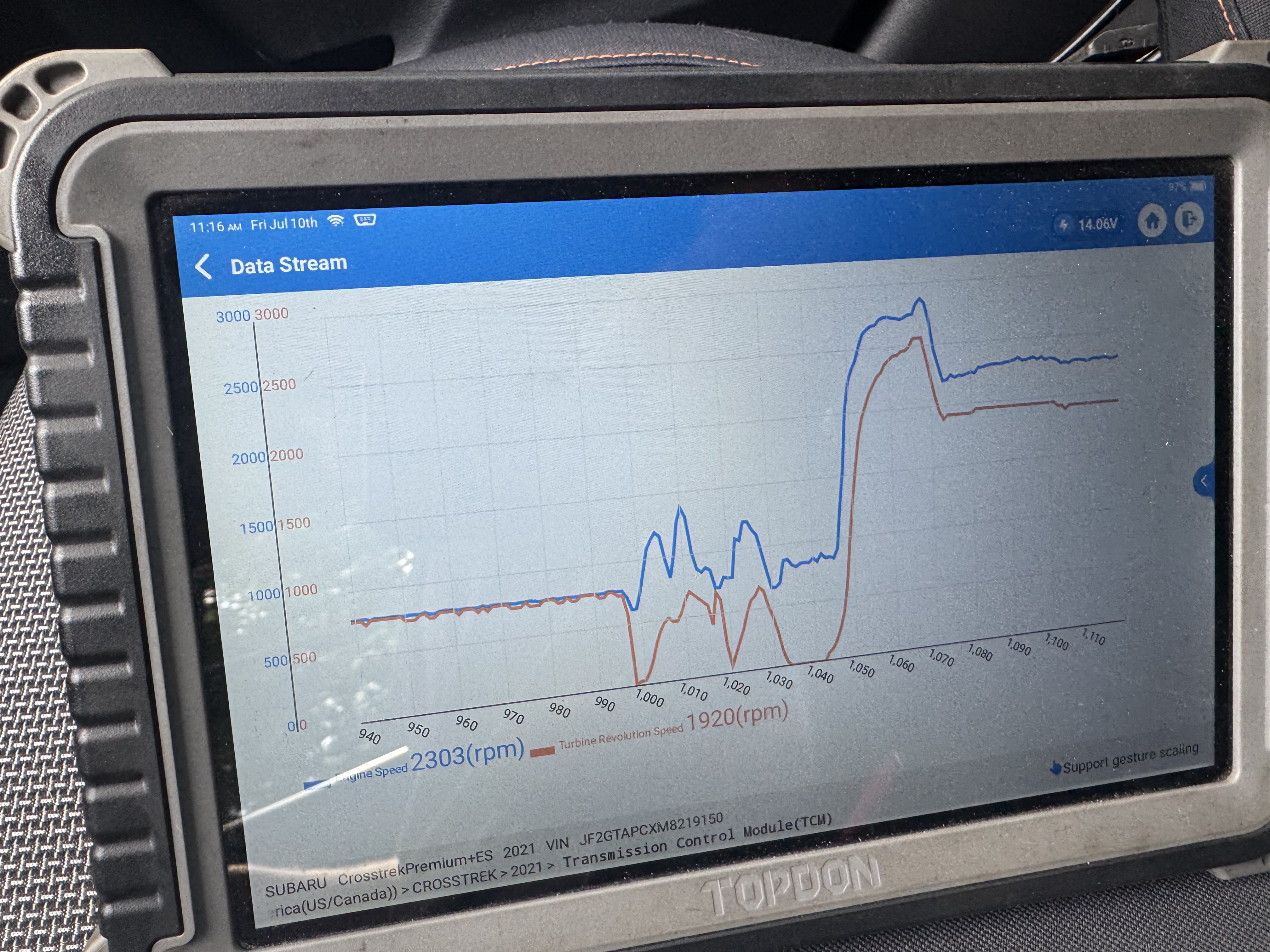
Diagnosing a P2757 torque converter clutch failure in a 2021 Subaru Crosstrek is a multi-step process that requires precision, knowledge, and specialized equipment. At College Highway Auto in Granby CT, we have developed a systematic approach to isolate the fault with accuracy, ensuring no unnecessary repairs are performed. The diagnostic process we follow includes: 1. Preliminary Code Scan: We start by scanning the vehicle’s transmission control module (TCM) for any stored trouble codes, noting P2757 and checking for related codes like solenoid electrical faults or sensor errors. 2. Visual Inspection and Wiring Check: The wiring harness and connectors related to the torque converter clutch solenoid and transmission sensors are carefully inspected for damage, corrosion, or loose connections that could cause intermittent faults or incorrect readings. 3. Ohm Testing of the TCC Solenoid: Using a digital multimeter, we measure the resistance of the torque converter clutch solenoid coil according to manufacturer specifications. In this case, the solenoid passed the ohm test, indicating the coil itself was not the problem. 4. Data Logging – TCC Duty Cycle, Engine RPM, and Turbine Shaft Speed: The key to confirming torque converter slipping involves logging live data while the vehicle operates. We connect to the vehicle’s controller area network (CAN) system and record the TCC duty cycle percentage (how much the solenoid is commanded to engage), the engine's RPM, and the turbine shaft speed inside the transmission. When the torque converter clutch locks correctly, the engine RPM and turbine shaft speed should closely match at higher duty cycles. Here, a noticeable gap indicated the torque converter was slipping despite correct solenoid operation. 5. Leak and Seal Inspection: A slipping torque converter can result from fluid leaks or degraded seals. We specifically checked the input shaft seals for wear or damage which could cause low fluid pressure and allow slippage. 6. Fluid Condition and Level Check: Transmission fluid quality and level directly affect torque converter clutch function. Though not the primary fault in this case, we verified that the fluid was at the correct level, clean, and not burnt or contaminated. 7. Test Drive and Driving Behavior Observation: We replicate customers’ driving conditions to confirm symptoms and observe how the transmission responds under load and at steady speeds. 8. Final Diagnosis: Compiling all gathered information confirmed that the P2757 code was triggered by a slipping torque converter clutch caused by internal mechanical failure and input shaft seal leakage—not by a faulty solenoid. This detailed process allows us to confidently recommend the next steps without unnecessary guesswork. For Subaru owners in Hartford County, Simsbury, East Granby, Suffield, and Windsor Locks, bringing the vehicle to a reputable Granby CT transmission specialist like College Highway Auto ensures a thorough approach that saves time and money and protects transmission health.
Once the diagnosis of torque converter clutch failure with input shaft seal issues was confirmed, we proceeded with a carefully planned repair to restore reliable transmission function to this 2021 Subaru Crosstrek. At College Highway Auto in Granby CT, our repair process includes the following steps: 1. Obtain Manufacturer-Specific Torque Converter and Seals: We sourced a high-quality replacement torque converter compatible with the Crosstrek’s transmission, alongside OEM input shaft seals to prevent future fluid leaks. 2. Prepare Vehicle: The vehicle was securely lifted, and the transmission fluid was drained into a clean container for inspection and proper disposal/recycling. 3. Transmission Removal: We carefully detached all electrical connectors, linkage cables, and fluid lines connected to the transmission. Transmission mounting bolts were removed while supporting the transmission with a hydraulic jack or transmission jack. 4. Transmission Separation: Once the transmission was lowered, the bell housing was separated from the engine block to access the torque converter and input shaft seals inside. 5. Torque Converter Removal: The faulty torque converter was freed from the input shaft and inspected for contamination and mechanical wear. 6. Seal Replacement: Old input shaft seals were carefully removed and the new seals installed with attention to proper alignment and lubrication to ensure a tight seal and prevent leaks. 7. New Torque Converter Installation: The new torque converter was aligned with the transmission input shaft and carefully seated to prevent damage to the fins and seal surfaces. 8. Transmission Reassembly and Reinstallation: The transmission halves were reassembled according to factory torque ratings and procedures. The transmission was then re-installed on the engine with all linkages, connectors, and lines reattached perfectly. 9. Fluid Replacement: We refilled the transmission with the manufacturer-recommended synthetic transmission fluid to ensure proper shifting and spline lubrication. 10. System Bleed and Calibration: After assembly, the transmission components were bled of air. We cleared previous fault codes and performed system relearns or calibrations as necessary using our scan tool. 11. Road Testing: The vehicle was taken on a comprehensive road test around Granby and nearby Hartford County areas including Simsbury and East Granby to verify the slippage symptoms were resolved, shifts were smooth, and no new codes returned. 12. Final Inspection and Customer Review: We inspected all seams for leaks, confirmed correct function, and walked the customer through the service performed, explaining maintenance recommendations and warning signs to watch for. This extensive, systematic repair process provides peace of mind that the torque converter clutch failure is permanently fixed and seals are effective at preventing future fluid loss. For Subaru drivers in Suffield, Windsor Locks, Granby CT and surrounding areas, entrusting a repair of this complexity to experienced technicians ensures transmission longevity and safe, fuel-efficient driving.
The torque converter clutch is a critical component for the Subaru Crosstrek’s transmission as it directly impacts fuel efficiency, transmission longevity, and driving comfort. When the torque converter clutch fails or slips, it prevents the transmission from locking up properly during cruising speeds. This leads to engine RPMs rising unnecessarily, causing reduced fuel economy—a significant concern for drivers in Hartford County where daily commuting and highway driving are common. Beyond efficiency concerns, a slipping torque converter can generate excessive heat inside the transmission, accelerating wear on internal components and fluid degradation. Left unaddressed, this can lead to more severe transmission failures, resulting in costly repairs that extend well beyond just replacing the torque converter itself. Additionally, failing input shaft seals cause transmission fluid loss, further compounding slippage problems and increasing the risk of transmission damage. For drivers in Granby, Simsbury, and nearby towns like East Granby and Suffield, timely diagnosis and repair not only restore smooth shifting and performance but also protect against cascading transmission failures. Correctly addressing the root cause of the P2757 code through detailed diagnostic procedures ensures that parts are only replaced when necessary, maintaining the vehicle’s reliability and value. Furthermore, understanding the importance of proper transmission fluid maintenance, including scheduled oil changes with full synthetic fluid and following Subaru’s recommended service intervals, can prevent future torque converter clutch failures. At College Highway Auto, we emphasize education to empower vehicle owners to make informed decisions, protecting their investment. Our location serving Granby CT and Hartford County provides local drivers with trusted, transparent service and expert repairs crucial for the demanding driving conditions and diverse terrain of the region.
The P2757 code indicates a problem with the torque converter clutch (TCC) system, generally that the TCC isn’t engaging properly or is slipping, which can affect transmission performance.
No, while solenoids are common failure points, this code can also be caused by mechanical issues like torque converter slipping or input shaft seal leaks.
By performing live data logging of the TCC duty cycle, engine RPM, and turbine shaft speed; if the engine RPM is higher than shaft speed at high duty cycles, it indicates slippage.
Yes, leaking seals can reduce hydraulic pressure vital for the torque converter clutch to lock up properly, leading to slippage.
Replacing the torque converter and input shaft seals requires removing the transmission and is labor-intensive, so costs reflect the complexity, but it’s necessary to prevent further transmission damage.
No, replacing the solenoid without confirming its failure can lead to unnecessary repair costs; thorough testing is essential before replacement.
Regular transmission fluid changes with the manufacturer-recommended full synthetic fluid at proper intervals help keep the TCC system operating smoothly.
Driving with a slipping torque converter is not advisable as it can cause poor fuel economy, increased heat, and further transmission damage over time.
Yes, we proudly serve customers throughout Granby CT, Hartford County, Simsbury, East Granby, Suffield, Windsor Locks, and surrounding areas.
This repair usually takes one to two full days to complete, given the removal and reinstallation of the transmission and precise component replacement.