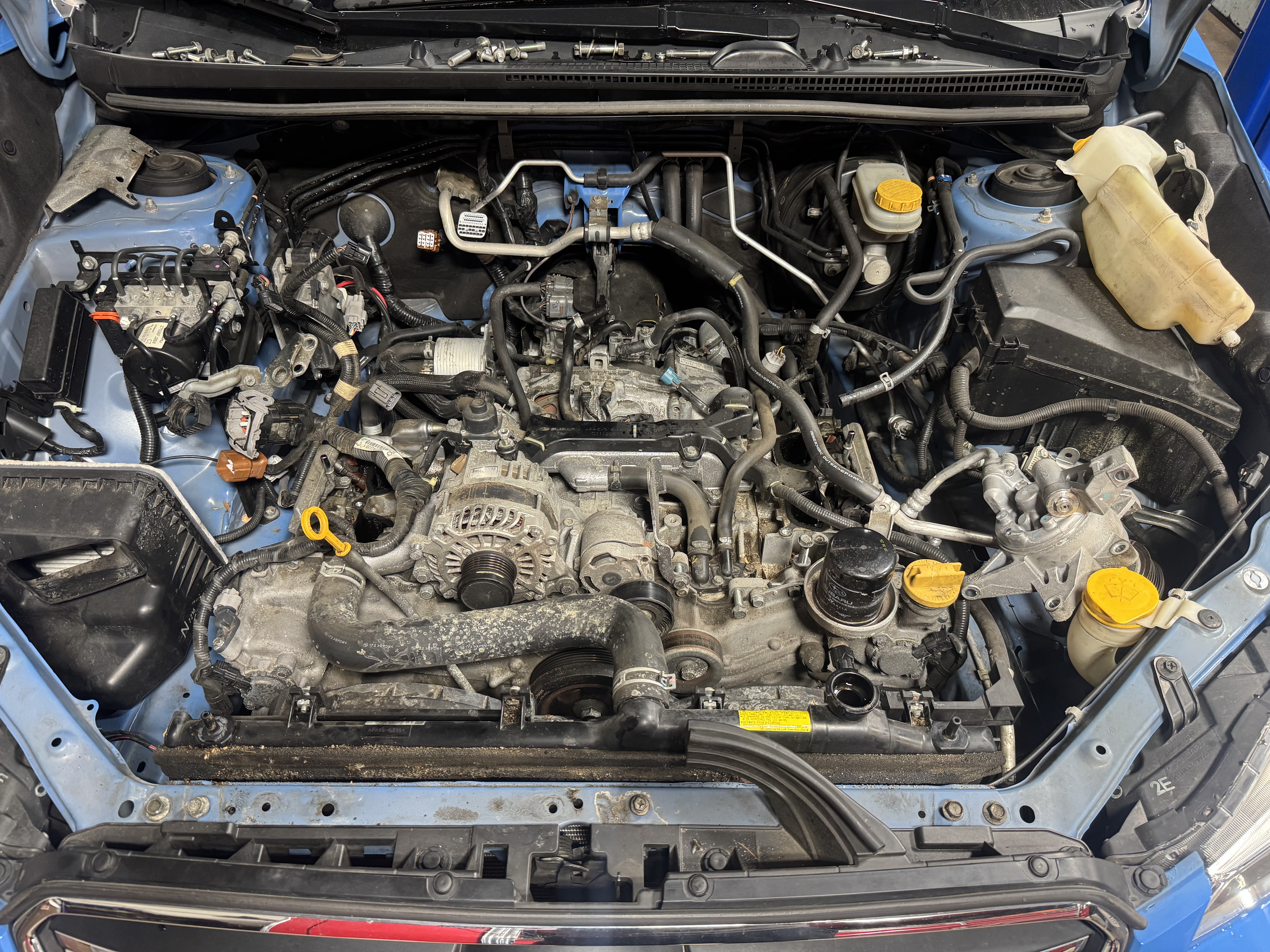
Diagnosing oil contamination in the radiator on a 2017 Subaru Crosstrek with FB 2.0 engine. Expert engine reseal services in Granby CT and Hartford County including upper oil pan seal replacement and full engine reseal.
At College Highway Auto in Granby CT, we frequently encounter the 2017 Subaru Crosstrek with an unusual but serious problem: engine oil found in the radiator. This issue is typically caused by failing seals, especially around the upper oil pan area of the FB 2.0 engine. Owners often notice this when they experience coolant contamination or overheating symptoms, which can lead to costly engine damage if not addressed promptly. In this detailed guide, we will walk you through the symptoms that indicate oil in the coolant, how we diagnose the issue step-by-step, and the best approach to repair including a full engine reseal if necessary. Our shop has specialized equipment such as a jet wash system to thoroughly clean engine components during reseal procedures, ensuring the highest quality repair and long-term reliability. Serving Granby and nearby towns like Simsbury, East Granby, Suffield, and Windsor Locks, we want Subaru owners to understand what causes this problem, how to catch it early, and why trusting a professional shop is critical for lasting results.
Oil contamination in the radiator on the 2017 Subaru Crosstrek can manifest in several ways that prompt owners to seek repair. One of the first noticeable symptoms is the presence of engine oil in the coolant reservoir or radiator. This contamination often results in a milky or frothy appearance in the coolant fluid, signaling cross-contamination between oil and coolant passages. Drivers may also experience engine overheating or fluctuating temperature gauge readings because the oil disrupts the normal coolant flow and heat transfer. Additionally, you might detect a sweet smell or notice coolant loss without visible leaks, further hinting at internal engine seal failure.
In some cases, owners come to us after routine maintenance where an engine oil level check raises suspicion. If the oil looks contaminated or abnormal sludge appears, it aligns with oil and coolant mixing inside the engine. At College Highway Auto, customers from Granby CT and surrounding Hartford County towns commonly report these symptoms for the FB 2.0 Crosstrek, as the upper oil pan seals are known trouble spots. While some issues might arise from head gasket failure or faulty oil coolers, our experience shows that most cases begin with degraded oil pan seals that allow oil to pass into the coolant system.
Importantly, extended oil change intervals exacerbate this problem. When synthetic oil change intervals extend beyond the recommended 3,000 miles without flushing, seals can harden and crack, accelerating oil leakage. That's why we stress the importance of regular synthetic 5W-30 oil changes for Subaru engines. Recognizing these symptoms early can prevent costly engine damage, and prompt diagnostics are essential to confirm the root cause before recommending repairs.
Diagnosing engine oil contamination in the radiator on a 2017 Subaru Crosstrek with the FB 2.0 engine requires a systematic approach to pinpoint the root cause and plan an effective repair. At College Highway Auto, we follow these detailed steps:
1. Initial Visual and Fluid Inspection: We begin by inspecting the coolant reservoir and radiator for signs of oil contamination such as milky discoloration or froth. Simultaneously, we check the engine oil for unusual contamination, which helps us confirm cross-contamination.
2. Check for External Leaks and Pressure Test Cooling System: We perform a visual inspection for leaks around hoses, gaskets, and oil cooler connections. Then, we pressure test the cooling system to identify internal leaks that might allow oil into the coolant passages.
3. Oil Pan and Seal Inspection: Given the prevalence of upper oil pan seal failure in the FB 2.0 engine, we remove engine covers as needed to inspect the oil pan seals for signs of leakage or damage.
4. Diagnostic Scan and Oil Pressure Check: We use professional scan tools to check for engine codes related to temperature sensors, head gasket failure, or oil pressure irregularities. We also measure oil pressure to ensure it’s within factory specifications.
5. Head Gasket Leak Testing: Although less common than pan seals, head gasket failure is still a possible cause. We conduct a chemical leak-down test or cylinder leak test to detect combustion gases in the coolant.
6. Coolant and Oil Sample Laboratory Analysis: In complex cases, we collect fluid samples for lab analysis to determine the exact contamination type and severity.
7. Component Removal for Direct Inspection: If initial steps don’t isolate the cause, we may need to remove the oil pan and engine heads for a thorough physical examination.
8. Consult Subaru Service Bulletins and Historic Repair Data: We cross-reference known Subaru FB 2.0 engine issues, ensuring that we follow best practices and manufacturer guidelines.
This diagnostic sequence ensures we are precise and thorough before recommending a costly engine reseal. While oil cooler failures or head gasket leaks are known causes in many engines, our shop in Granby CT has learned through extensive experience that the upper oil pan seals are most often the culprit on Crosstreks. By accurately diagnosing the problem, we avoid unnecessary repairs and provide our customers in Hartford County and nearby towns like Simsbury and East Granby the confidence to move forward with proven solutions.
Once diagnosis confirms the upper oil pan seals are leaking and causing contamination of engine oil into the coolant on the 2017 Subaru Crosstrek, repair typically involves a thorough engine reseal. At College Highway Auto, we approach this with precision and care, particularly for the FB 2.0 engine which requires detailed disassembly.
1. Engine Removal or Partial Disassembly: Depending on the vehicle’s condition and customer preferences, we may remove the engine or access key components in the vehicle. The upper oil pan seal replacement requires careful removal of engine components such as intake manifolds and timing covers.
2. Full Engine Disassembly for Reseal: Since the customer in this case requested a full engine reseal including head gaskets, we remove cylinder heads, timing components, oil pans, and cam carriers. This level of disassembly is extensive and only performed to ensure maximum durability.
3. Jet Wash Cleaning Process: We use a specialized jet wash system designed for engine parts to clean off all sludge, old gasket material, and contaminants from heads, cam carriers, and oil pans. This step is crucial to ensure new seals and gaskets properly adhere and prevent future leaks. Without this precise cleaning, repairs might fail prematurely.
4. Gasket and Seal Replacement: We replace all upper oil pan seals, head gaskets, valve cover gaskets, cam carrier seals, and other relevant seals according to Subaru specifications. We use high-quality OEM or equivalent seals designed for the FB 2.0 engine.
5. Component Inspection and Machining as Needed: We inspect the flatness of cylinder heads, cam carriers, and oil pan surfaces. If warping or damage is detected, we perform professional machining to restore proper sealing surfaces.
6. Reassembly: Meticulous reinstallation of all components with proper torque sequence and settings following Subaru repair guidelines. We are careful to avoid any contamination during reassembly.
7. Fluid Replacement and System Bleeding: We refill the cooling system with the recommended coolant and replace the engine oil with full synthetic 5W-30. We also bleed the cooling system to remove trapped air.
8. Post-Repair Testing: We conduct thorough engine performance checks including pressure tests of the cooling system, oil pressure verification, and computer diagnostics to ensure no fault codes or abnormal readings.
9. Road Test and Monitoring: A road test under varying conditions allows us to verify stable engine temperatures and no recurrence of oil contamination.
Throughout this process, we communicate transparently with customers from Granby CT and nearby communities such as Suffield and Windsor Locks. We emphasize the importance of proper maintenance schedules, particularly 3,000-mile synthetic oil changes, to protect seal integrity and prolong engine life. The attention to detail and our investment in advanced cleaning technology set College Highway Auto apart for trusted Subaru engine reseal services.
Understanding why an engine reseal on your 2017 Subaru Crosstrek matters goes beyond simply fixing leaks — it's about protecting your vehicle’s engine longevity and your peace of mind. When oil contaminates the coolant, as often seen with the FB 2.0 engine upper oil pan seals failing, the consequences can quickly become severe. Oil in the cooling system reduces the coolant’s ability to absorb and dissipate engine heat, resulting in overheating which accelerates engine wear and increases the risk of head gasket failures or even engine warping.
Moreover, contamination can plug radiator passages and heater cores, causing localized overheating and inconsistent cabin heating. Left unresolved, this can lead to costly cylinder head damage and decrease overall engine reliability. Fixing the root cause with a professional reseal isn't just about stopping leaks; it restores system integrity, maintains proper lubrication and cooling balance, and prevents progressive engine damage.
At College Highway Auto, serving Granby CT and the greater Hartford County region, we emphasize proper maintenance protocols alongside repairs. Many cases of seal failures can be partly attributed to extended oil change intervals and the use of lower quality oils. We recommend synthetic 5W-30 oil changes every 3,000 miles to keep seals supple and prevent them from hardening and cracking.
Choosing a shop experienced with Subaru FB 2.0 engines is critical. Our in-depth understanding of common failure points and investment in equipment like jet wash cleaning technology ensures repairs last longer and deliver full performance restoration. For Subaru owners in Simsbury, East Granby, Suffield, Windsor Locks, and nearby towns, addressing oil contamination proactively can save thousands in future repairs and extend your Crosstrek’s trusted service life. We want every repair to matter—not just for today but for years down the road.
On the 2017 Subaru Crosstrek with the FB 2.0 engine, the most common cause of oil-contaminated coolant is failing upper oil pan seals. These seals separate the engine’s oil and coolant passages, and when they degrade, oil can leak into the cooling system.
While head gasket failure can cause coolant and oil to mix, in the FB 2.0 engine of the 2017 Crosstrek, oil pan seal leaks are usually the primary culprit. Comprehensive diagnostics are needed to confirm the exact cause.
We perform a detailed inspection including visual fluid checks, cooling system pressure tests, oil pan seal inspections, scan for codes, and chemical tests of fluids. Sometimes, removal of components is required for direct inspection.
Replacing just the oil pan seals can leave other vulnerable seals untouched. A full engine reseal, including head gaskets and cam carrier seals, ensures all potential leak points are addressed, providing a more reliable long-term repair.
Our jet wash system cleans engine components thoroughly, removing sludge and old gasket material, which improves seal adhesion and extends the life of the repair. Without this, repairs can fail sooner.
We recommend full synthetic 5W-30 oil changes every 3,000 miles to keep seals in good condition and prevent hardening or cracking that leads to leaks.
Extended oil change intervals are not recommended for Subaru FB 2.0 engines. Longer intervals can cause seal degradation and contribute to oil and coolant contamination problems.
It is not advisable to drive extensively with oil in the radiator as it compromises cooling efficiency and can lead to overheating and serious engine damage. Early diagnosis and repair are essential.
A full engine reseal is an extensive job usually taking several days depending on parts availability and any machining needed, as it involves disassembly, cleaning, gasket replacement, and reassembly.
Yes, at College Highway Auto we back our repair work with warranties on parts and labor to ensure your peace of mind and long-term reliability.
Absolutely, we serve the greater Hartford County area including Simsbury, East Granby, Suffield, Windsor Locks, and neighboring towns.